

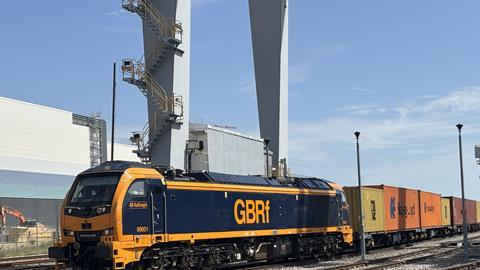
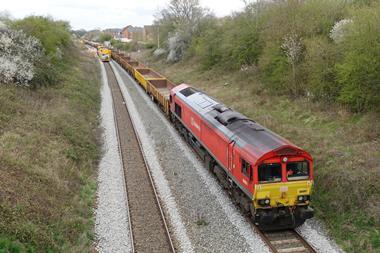
GB Railfreight has operated the first commercial service of its new Class 99 hybrid freight locomotive, introducing a lower-emission solution designed to support Britain’s growing rail freight sector.
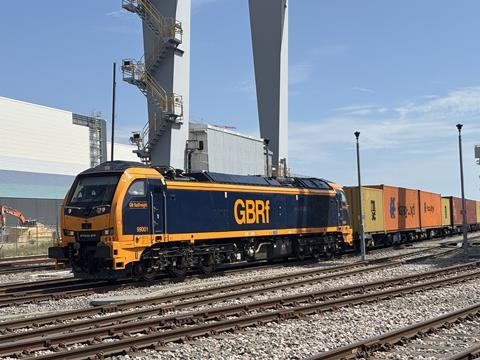
GB Railfreight (GBRf) has launched the UK’s first commercial service using its new Class 99 hybrid freight locomotive, marking a significant milestone in the decarbonisation and modernisation of Britain’s rail freight network.
The inaugural commercial service departed DP World London Gateway carrying intermodal freight for Maritime Transport’s Hams Hall Rail Freight Terminal in the West Midlands. The journey marks the first operational deployment of the Class 99 locomotive following more than four and a half years of planning, engineering and testing.
Representing a £150 million investment, the new fleet combines electric traction with the ability to operate on non-electrified routes using renewable fuels. The dual-mode capability enables services to continue across the national rail network without relying solely on electrified infrastructure, which currently covers around 40% of Britain’s railway.
Hybrid technology supports freight decarbonisation
According to GB Railfreight, the Class 99 locomotives are expected to reduce emissions by more than half on a typical journey while providing improved performance and faster acceleration. This allows freight services to integrate more effectively with passenger operations, increasing network efficiency and supporting future growth in rail freight.
The first commercial train operated for Maritime Transport, moving containers from London Gateway to Hams Hall using the new locomotive.
John Smith OBE, Chief Executive Officer of GB Railfreight, said: “Four and a half years ago, we set out to bring a locomotive to the UK that would redefine what rail freight could deliver. Today, with the first commercial Class 99 service departing London Gateway for Hams Hall, we’ve achieved exactly that.”
He added: “The Class 99 combines lower emissions, better performance and a modern, safer working environment for our drivers.”
John Bailey, Managing Director – Intermodal at Maritime Transport, said the locomotive would support the company’s strategy of moving more freight from road to rail while integrating services with its expanding electric HGV fleet.
DP World also highlighted the importance of the new locomotive for operations at London Gateway. Kris Adams, Chief Executive Officer of UK Ports and Terminals at DP World, said the investment would help maximise rail terminal capacity while enabling more sustainable freight movements and reducing road mileage across UK supply chains.
Developed through a partnership between GB Railfreight, Stadler, Beacon Rail and Network Rail, the Class 99 has been designed to support the Government’s ambition of increasing rail freight by 75% by 2050 while contributing to the sector’s continued role in the UK economy, where rail freight currently generates around £2.5 billion annually.




No comments yet