
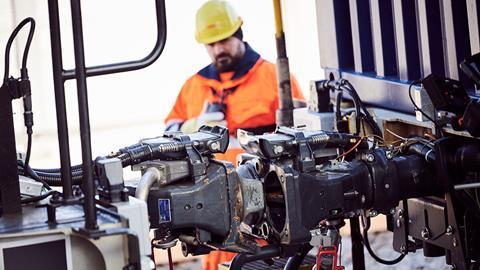
ÖBB has demonstrated Digital Automatic Coupling under real operating conditions at Floridsdorf freight station in Vienna, comparing the technology directly against the screw coupler currently used across European rail freight, as the sector moves towards its deployment in commercial operations.
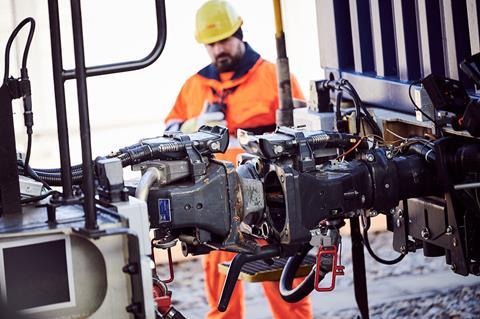
ÖBB has demonstrated Digital Automatic Coupling (DAC) at the Floridsdorf freight yard in Vienna under real operating conditions, comparing the screw coupler currently used across European rail freight with the capabilities of DAC.
DAC is regarded across Europe as one of the most important innovation projects for rail freight, combining automation, digitalisation and productivity improvements as part of a joint European initiative aiming to make rail freight more efficient, competitive and attractive. Peter Hanke, Federal Minister for Innovation, Mobility and Infrastructure, said: “An efficient railway freight transport system is crucial for Austria as a business location. The Digital Automatic Coupling demonstrates how innovation can drive the rail sector forward. It improves safety and working conditions for staff, speeds up processes and lays the foundation for further digitalisation steps along the entire transport chain.”
Technology enables automated coupling and continuous data transmission
ÖBB has been involved in European development and demonstration projects on DAC for many years. The technology enables automatic coupling and uncoupling of freight wagons, as well as continuous transmission of power and data along the train, enabling applications such as automated brake tests and digital recording of wagon order, with train integrity monitoring a future use case. ÖBB said manual tasks are reduced and staff safety increased, with the technology also opening possibilities for longer, heavier freight trains and more efficient use of capacity.
ÖBB CEO Andreas Matthä said: “The DAC is far more than just a new coupling. It is the foundation for the digital freight train of the future and thus for safer and more competitive railway freight transport in Europe. With our demonstrator train, we are demonstrating today that the technology works under real-world conditions.”
As part of the Europe’s Rail FP5 TRANS4M-R project, a specially equipped Austrian demonstrator train is testing the technology under real-world conditions, gaining insight into technical reliability, safety, maintenance and integration with existing processes. For the first time, this includes locomotives fitted with DAC alongside freight wagons, with tests to date, including winter trials in Austria, informing further development ahead of Europe-wide deployment.
Pioneer DAC Trains to be focus of attention for next three years
Responding to questions from Global Railway Review on the timeline for wider deployment, ÖBB said the Pioneer DAC Trains represent the next major step, bringing the technology from the demonstration and trial phase into commercial rail freight transport for the first time under real-world market conditions. The company said the aim is to further demonstrate technical and operational maturity, achieve regulatory approval and provide robust evidence of the economic benefits.
ÖBB said the ongoing demonstrations and the Pioneer DAC Train projects will be the focus of attention over the next three years. A Europe-wide roll-out has not yet been decided, the company said, and can only take place once key prerequisites have been met, including a harmonised European system, proven functional and operational benefit, suitable authorisation procedures, a viable business case, and funding and support, alongside a coordinated European migration plan. ÖBB said: “DAC can only realise its full potential if it operates in a way that is interoperable across Europe.”
Retrofitting costs and financing yet to be determined
On the cost of converting wagons from screw couplers to DAC, ÖBB said it is not yet possible to give a reliable figure per wagon or coupling operation, as actual costs depend on vehicle type, technical equipment, registration and installation costs, and the eventual migration scenario. The company said the demonstrator trains and Pioneer DAC Trains are intended to provide the basis for a robust assessment of technical maturity, operational benefits and cost-effectiveness under real-world conditions.
ÖBB said it is nonetheless clear that subsequent series-scale retrofitting of locomotives and freight wagons will require substantial investment, and that how this will be financed has not yet been decided at European level. From today’s perspective, the company said, this is likely to require a combination of contributions from national and European funding schemes, adding that the migration needs to be approached jointly, in a coordinated manner and with a Europe-wide perspective, since rail freight transport operates across borders and DAC must be introduced in the same way.

No comments yet