


The HVC-MG and H1C-MG rails introduce redesigned ball cages and integrated magnets, targeting higher loads, smoother movement and longer service life.
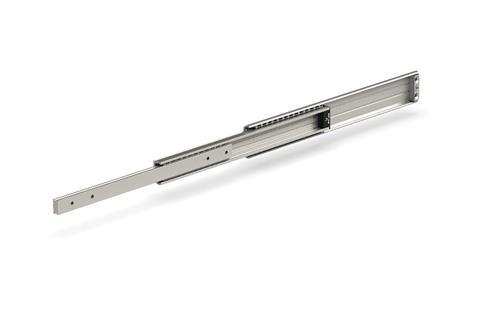
Rollon has expanded its range of telescopic rails with the launch of the HVC-MG and H1C-MG, introducing an updated design aimed at improving load capacity, motion control and durability in demanding applications.
The new products are an evolution of Rollon’s existing HVC and H1C telescopic rail families, with the MG versions incorporating a redesigned ball cage and integrated magnets. The company says the changes are intended to address operational requirements where equipment must be moved smoothly and reliably while supporting significant loads.
New design targets higher loads and smoother movement
The MG configuration combines a reduced-pitch ball cage with end blocks containing internal magnets. By reducing the pitch, more balls can be accommodated within the same cage length, increasing the load capacity without changing the overall dimensions of the rail.
The integrated magnets control the sequence in which the rail elements open during extension. This provides more controlled movement and reduces the force required to open the rail, which can improve ergonomics for operators working with equipment during maintenance or other servicing activities.
The design also distributes loads more effectively across the rail. According to Rollon, this can reduce stress on the raceways and contribute to longer service life and more consistent performance over time.
“After successfully introducing this technology on the HGT range, we are now extending it to additional telescopic rail families,” says Andrea Tosi, VP Technology at Rollon. “The integrated magnets enable an ideal combination of high load capacity and smooth and controlled motion. This development reflects our ongoing commitment to engineering solutions that go beyond meeting technical specifications, addressing the real operational challenges our customers face across industrial applications.”
The MG version is currently available for sizes 54 and 68 of the HVC range, and size 68 of the H1C range.
Railway applications
HVC and H1C rails are designed to provide accessibility while limiting the space required for installation. The HVC is a full-extension solution, while the H1C provides over-extension capabilities.
The rails and sliders are manufactured from steel with zinc electroplating, while additional surface treatments can provide increased resistance in demanding environments. HVC slides can also be supplied in stainless steel where greater corrosion protection is required.
Their characteristics make the products suitable for railway applications where onboard components need to remain accessible for inspection and maintenance while operating in environments exposed to vibration, shocks, humidity and contaminants.
Potential applications include battery compartment extraction and access to other onboard equipment. In these situations, controlled movement can help operators handle equipment more easily while maintaining structural support.
“The MG version directly addresses these needs by improving motion control and reducing operating forces, even under heavy loads”, explains Andrea Tosi.
The development therefore reflects a wider requirement within rail vehicle design to balance accessibility, durability and efficient maintenance. Components used around onboard equipment must provide dependable performance while fitting within increasingly constrained vehicle layouts.
Products to be showcased at InnoTrans
Rollon will showcase the HVC-MG and H1C-MG at InnoTrans in Berlin from 22 to 25 September 2026.
The launch also extends the company’s use of magnetic sequential-motion technology beyond its existing HGT range. For rail applications, the technology provides another option for equipment requiring repeated extension and retraction while carrying substantial loads.
The company positions the new rails as part of its wider portfolio of linear motion products for automation and transport applications, with the railway sector representing one area where reliability, accessibility and service life are particularly important.






No comments yet