
Two battery-powered regional trains have entered service in France, supporting trials of cleaner alternatives for non-electrified regional railway lines.
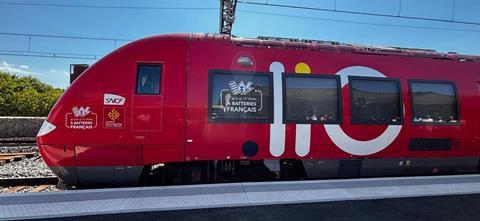
Alstom, SNCF Voyageurs and five French regions have begun commercial operations of the country’s first battery-powered regional trains, marking a significant step in efforts to reduce diesel use on non-electrified railway lines.
The two trains are operating in Occitanie and the Sud Region, where they will be tested under real operating conditions. The €41 million national programme is designed to assess the performance of battery-powered rolling stock and establish the conditions required for wider deployment across France.
Battery trains enter regional service
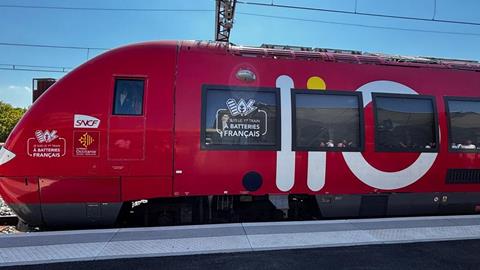
In Occitanie, the first battery-powered liO train entered service on the Nîmes to Vauvert line on 31 August. The launch was attended by representatives from the Occitanie Region, SNCF Voyageurs and Alstom.
The project forms part of the region’s wider strategy to reduce diesel use while maintaining and developing rail services on lines without full electrification. The introduction of the battery train will also support two additional return journeys on weekdays on the Nîmes to Vauvert route.
Occitanie is already testing different approaches to railway decarbonisation. Alongside the battery-powered train, the region has previously been involved in trials of a trimode electric, diesel and battery Régiolis train and is preparing to introduce hydrogen-powered Régiolis trains on the Montréjeau to Luchon line.
This means Occitanie is testing three technologies designed to reduce reliance on diesel across its regional rail network.
The second battery-powered train has been operating commercially in the Sud Region since 28 July 2026 on the Avignon to Carpentras line.
The train uses conventional electric power on electrified sections before switching to battery operation at Sorgues station. It then continues to Carpentras across the non-electrified section of the route.
This approach demonstrates how battery traction can be used alongside existing electrification rather than requiring entire routes to be electrified. It provides operators with another option for reducing diesel use where installing overhead infrastructure may not be the immediate solution.
Converting existing trains for lower emissions
The two trains have been created by converting existing high-capacity AGC railcars. Their diesel engines have been replaced with lithium-ion batteries, giving the trains a range of more than 80 kilometres.
The trains can also recover energy generated during braking and store it in their batteries. Alstom says this can deliver energy savings of up to 20 per cent, while battery operation removes direct CO2 emissions during service.
The technology is also intended to improve the passenger environment, with quieter operation compared with conventional diesel-powered trains.
The national programme brings together Occitanie, the Sud Region, Auvergne-Rhône-Alpes, Hauts-de-France and Nouvelle-Aquitaine, alongside SNCF Voyageurs and Alstom.
The €41 million investment comprises €30 million from the five participating regions, €6 million from SNCF Voyageurs and €5.5 million from Alstom.
“Together with Occitanie, the Sud Region and SNCF Voyageurs, we are taking a significant step forward in the development of more sustainable rail solutions.”
Frédéric Wiscart, President of the France BeLux region at Alstom, said the programme demonstrates how existing rolling stock can be transformed to reduce its environmental footprint while continuing to meet passenger mobility requirements.
The trials will provide operational experience that can help determine where battery-powered trains could be deployed more widely. For regional operators, the technology offers a potential route to decarbonising services where full electrification is not currently in place.
The projects also demonstrate the importance of combining different traction technologies rather than relying on a single solution. Battery, hybrid and hydrogen trains are being explored alongside conventional electrification as France seeks to reduce diesel consumption across its regional railway network.






No comments yet