

A five-point plan from the Federal Ministry of Transport and DB InfraGO postpones eight planned corridor renovations, adds phased commissioning and more stable diversion routes, and sets ETCS Level 2 without signals as the default from the early 2030s.

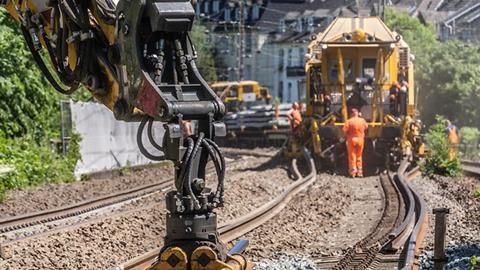
The Federal Ministry of Transport (BMV) and DB InfraGO have cut the number of corridor renovations planned in Germany between 2027 and 2031 from 21 to 13, as part of a five-point plan intended to make both rail traffic and construction work more reliable.
The revised concept also makes ETCS (European Train Control System) a standard element of corridor renovations, introduces phased commissioning after construction and commits to more stable diversion routes. The BMV and DB InfraGO said no corridor renovation will be cancelled, only postponed.
Fewer corridors, better balance with traffic
The ranking has been adjusted to focus on the projects offering the greatest benefit in terms of quality, stability and punctuality. According to the BMV and DB InfraGO, the reduction also reflects limited transport capacity on the busy German network and the resources of the construction industry. Necessary replacement investments will go ahead regardless of the postponement. Prioritisation of corridor renovations from 2032 onwards will take place next year.
Steffen Bilger, Federal Minister of Transport, said: “In the future, corridor upgrades must demonstrably lead to greater reliability and punctuality on the railways.”
DB InfraGO is also intensifying preparations for diversion routes and coordinating the construction schedule with other work on the network, rescheduling sites or adjusting processes to create more capacity for traffic. For the Lehrte to Berlin corridor, which has been under construction since October, a second diversion route for freight traffic will be available from February.
Without the consistent bundling of construction projects, the renovation of our dilapidated infrastructure would take even longer.”
ETCS becomes the standard
From the beginning of the 2030s, ETCS Level 2 without signals will be installed as a matter of course in every corridor renovation. This is contingent on appropriate consultations with the railway undertakings in accordance with the applicable legal regulations.
In the years before a renovation, DB InfraGO generally prepares for digital train control where technically feasible. All modernised signal boxes are ETCS-compatible, and adapted signal locations and modern axle counting are installed, as on the Hamburg to Berlin line. Conversion to ETCS Level 2 without signals can follow once the rolling stock has been largely converted.
On some sections, including Troisdorf to Wiesbaden and Rosenheim to Salzburg, the interim technology ETCS Level 2 with signals is planned, as agreed with the industry. That technology has been fully operational between Frankfurt and Mannheim since the middle of the year.
Phased commissioning and a three-phase model
Train services will in future be ramped up gradually, generally starting with freight test runs, with passenger trains following somewhat later. In the first few weeks, extra buffer time can be planned and some operational restrictions or reduced capacity maintained.
A commissioning team will manage the transition from construction project to regular operation and ensure that minor defects, which only become apparent in service, are addressed quickly. Planning is already under way for the commissioning of the Obertraubling to Passau and Troisdorf to Wiesbaden corridors, scheduled for mid-December 2026.
DB InfraGO is also introducing a three-phase model consisting of preparatory, main and follow-up phases. Measures that do not need major operational restrictions will be carried out before or after the main closure wherever possible, particularly complex signalling and safety work. On the two renovations currently under way, new signalling will be built during the main closure, with commissioning partly following through short, temporary closures in 2027 that will be built into timetables.
Evelyn Palla, CEO of Deutsche Bahn, said: “Without the consistent bundling of construction projects, the renovation of our dilapidated infrastructure would take even longer.”
The renovation promise of one construction phase, followed by up to 10 years largely free of major construction-related disruption, remains in place. The BMV and DB InfraGO are maintaining their goal of an 80 percent reduction in infrastructure-related disruptions, but now say this should be achieved no later than 100 days after commissioning rather than immediately.
Corridor sequence to 2031
Three corridors are planned for 2027: Lehrte to Berlin, Rosenheim to Salzburg and Fulda to Hanau. The 2028 programme comprises Cologne to Koblenz, the first stage of Munich to Rosenheim, Hagen to Unna to Hamm, and Lübeck to Hamburg. In 2029, the corridors are Hamburg to Hanover, Würzburg to Ansbach to Treuchtlingen, and Aachen to Cologne. Stendal to Magdeburg and Uelzen to Stendal follow in 2030, with Lehrte to Groß Gleidingen and the second stage of Munich to Rosenheim planned for 2031.
The BMV and DB InfraGO pointed to results from completed renovations. Long-distance trains now depart the Riedbahn between Frankfurt and Mannheim 20 percent more punctually than they entered it. On the Nuremberg to Regensburg line, infrastructure-related disruptions have fallen by more than 90 percent since completion in the summer. That renovation and the Hagen to Wuppertal to Cologne project both finished below projected costs.
Implementation on individual corridors will be developed jointly by the BMV and DB InfraGO with industry representatives and the federal states, and dialogue formats for this have been initiated.



No comments yet