

GRR explains: railways must prepare staff for FRMCS while GSM-R keeps running, and EU-Rail’s surveys record concern about skills and training.
Railways have to train people for a radio system that is not finished while they keep the one it replaces running. That is the timing problem with the Future Railway Mobile Communication System (FRMCS). Staff must learn it while the Global System for Mobile Communications – Railway (GSM-R) carries live traffic, and parts of the specification are still being written.
EU-Rail has been asking the sector whether it is ready. Its 2025 questionnaire found concern about the availability of competent people and about training that was too generic and high-level. Its 2026 questionnaire, presented on 7 October, was blunter about infrastructure managers: ”Hardly any activities started on knowledge building or competence development”.
The decision in front of every head of telecoms is which skills to grow in-house, which to recruit and which to buy in from suppliers. It also reaches well beyond telecoms engineers, because drivers, controllers and maintainers will use the system or the procedures built around it.
The technology, explained
FRMCS is the successor to GSM-R and was included in the 2023 Control-Command and Signalling Technical Specification for Interoperability (CCS TSI). GSM-R is, in the words of Karel van Gils of Europe’s Rail (EU-Rail), “a 2G technology that mobile operators are phasing out.” FRMCS is built on 5G and on standards from the 3rd Generation Partnership Project (3GPP), and it adopts 3GPP mission-critical applications. Van Gils calls the move “a technological leap directly from GSM-R to FRMCS,” with no 3G or 4G stage in between. GSM-R covers more than 130,000km of track in Europe, with about 90,000 cab radios activated, according to the International Union of Railways (UIC).
Why FRMCS training starts before the specification is final
The technology changes more than the radio. UIC’s FRMCS V2 Engineering course, scheduled over four days in October 2025, lists the new ground: the standards-based approach, 5G, migration paths from GSM-R, radio spectrum and 3GPP mission-critical applications. UIC addresses it to people who have worked with GSM-R in rail or have a telecoms background from commercial cellular. Network Rail’s FRMCS Fundamentals is a 120-minute e-learning introduction to digital railway technologies. That builds awareness. It is not the training needed to design, deploy, integrate or maintain an FRMCS network.
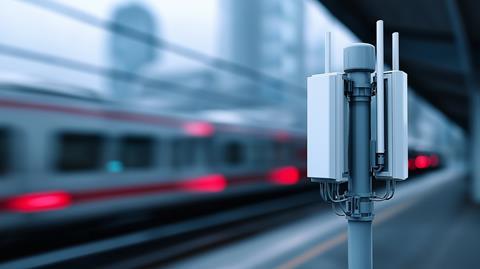
The audience is wider than telecoms. FRMCS cab radios and dispatcher systems interface with the European Train Control System (ETCS), automated train operation (ATO) and train control and monitoring systems (TCMS). Drivers, controllers, maintainers and operational managers need to understand the equipment and the procedures that change with it.
The specification those courses teach is not finished. UIC’s plan has Version 3p due in November 2026 and the ERA-approved Version 3 in December 2027, and UIC said in April 2026 that it had executed every milestone of its plan so far. Those are targets, not delivered documents.
EU-Rail’s System Pillar report of October 2025 is less optimistic. It puts the recommendation from the European Union Agency for Railways (ERA) in December 2027 at best or September 2028 at worst, and the amended CCS TSI in June 2028 or June 2029, against an original Q2 2027. It also records that UNIFE, the European rail supply industry association, did not agree that the scope could be delivered in the timeline UIC proposed. ERA’s own December 2024 opinion called validating Version 3 on that timetable “extremely challenging”.
The group that writes the specification is small. ERA’s opinion records three full-time equivalents on the Version 2 review and about 10 more on the experts’ side, who found being represented in every meeting “quite challenging”. UNIFE’s input to the System Pillar in April 2025 called the lack of industry participation and expertise in drafting Version 2 “a clear lesson learnt”. Those figures count specification work. They do not measure a shortage of operational staff.
Laboratory tests at three European sites, hosted by Ericsson, Nokia and Kontron, began in July, with field trials on operational lines due from 2027 at Adif, DB InfraGO, ProRail and Trafikverket. Those railways will be the first to run FRMCS equipment outside a laboratory.
That leaves a dilemma, and the sector is feeling it: in the 2026 questionnaire “Many respondents wait for next steps on outcome UIC programme, MORANE2 and TSI process”. Train too early and staff learn details that change. Wait for the final version and capability arrives just as deployment preparation speeds up. The way through is to teach now what is unlikely to change and hold equipment-specific and national content until specifications, equipment choices and deployment plans are final.
GSM-R’s end date is no firmer. UIC’s FRMCS page expects end of support around 2035, UIC’s 2023 course announcement said around 2030 and the System Pillar report says GSM-R will start to be life-expired by 2030. These are not necessarily the same milestone. The operational point is clearer than any of them: GSM-R must keep working during the transition, and railways cannot lose the people who understand it before its replacement is ready. In the 2026 questionnaire, several infrastructure managers said they intend to use it after 2040.
By the numbers
What the sector has measured about FRMCS skills, and the clock it runs against:
- 81 respondents from 23 countries answered EU-Rail’s 2026 deployment questionnaire, up from 67 in 2025
- Early November 2026 is when EU-Rail says the report on the 2026 questionnaire will be published
- Three full-time equivalents at ERA and about 10 on the experts’ side worked on the Version 2 review
- November 2026 is when UIC plans Version 3p, with an ERA-approved Version 3 in December 2027
- Around 2035 is when UIC expects end of support for GSM-R
- Before 2032 is when half of infrastructure managers intend to start deployment, while several plan to use GSM-R after 2040
- 2035 is the deployment-readiness date that railway undertakings and lessors call “unrealistic”.
What EU-Rail’s surveys say about FRMCS training
EU-Rail’s 2025 FRMCS Deployment Questionnaire drew over 60 answers from 20 countries, among them 19 infrastructure managers, 26 railway undertakings, five trackside providers, five on-board providers and 11 national safety authorities. Its presentation records concern about the availability of competent resources “whatever the job is concerned” and says the trainings on offer “seem not to fulfil the demand as they are very generic and high-level”. Some safety authorities are not sure they have the expertise they will need.
The High-Level Deployment Group took the point to ERA in February 2026. Its advice records “significant concerns” about the availability of resources and competences for the deployment and says awareness of the transition is “very limited”, in particular among smaller countries, railway undertakings and lessors.
The second questionnaire widened the field to mobile network operators and notified bodies. EU-Rail presented the results on 7 October: 81 respondents from 23 countries, against 67 in 2025. The responses showed greater knowledge of the transformation and a move, in the deck’s words, “from awareness to involvement”. Skills are the laggard for infrastructure managers. The key findings flag a risk of lack of engineering resources “to be investigated”, skilled-resource concerns come from some national safety authorities and from the notified bodies, and industrial capacity needs investigating too. Some safety authorities say they are not aware of the authorisation process specific to FRMCS.
The sector has also proposed a fix of its own. EU-Rail’s Report on the FRMCS Migration Scenarios 2025, dated 19 December 2025, says there is a need to introduce a European Support Competence Center to enable and share knowledge about deployment scenarios, lessons learnt, new procedures and test and validation issues during the transition period. The Deployment Group’s 2026–27 work plan, approved two months later, includes a report estimating the capacities needed but does not list a training or competence-centre deliverable. That does not show nobody is working on it. It does show a proposal with no published delivery route.
The caveat matters. These surveys record what respondents reported, and only three notified bodies answered, too few for a clear picture. They are not a census of the railway workforce, and they do not say how many FRMCS engineers Europe needs, what training will cost or who should pay for it.
Where FRMCS skills will come from
A railway has three routes: retrain the staff who already run GSM-R, recruit people with commercial mobile-network or cloud expertise or buy specialist support from suppliers and contractors. Most will use all three.
Start with the people already there. Railway telecoms teams know railway operations, safety requirements, legacy equipment and what a communications failure costs. They are needed while GSM-R and FRMCS run side by side, and EU-Rail’s System Pillar report lists “the declining expertise in legacy technology” among the operational risks of the 2G systems. The transition is not a clean break, so that knowledge has to be kept and passed on.
Railway experience will not cover everything. Emanuele Di Liberto, Head of Global Rail Business Center at Nokia, speaking to Global Railway Review, said that teams that have run 2G for 20 or 25 years can learn 5G, but that every railway should also “inject a bit of net new competence about the new technology,” in particular around 5G and the cloud core. Weigh the source: Nokia supplies FRMCS equipment and hosts one of the three MORANE-2 laboratories. His view supports recruitment as one route. It is not a neutral account of the only route. UIC’s course pages point to the same two pools, people with GSM-R or railway telecoms experience and people from commercial cellular. Neither arrives knowing everything FRMCS needs.
Buying in is already under way. Most railway undertakings told EU-Rail in 2025 that they expect to use external resources to deploy FRMCS, smaller ones rely on subcontracting and railway undertakings expect train manufacturers to support engineering, homologation and workshop capacity. A majority of infrastructure managers also expect to use public mobile network operators, so part of the telecoms work may sit outside the railway altogether.
FRMCS readiness does not belong to one organisation. Railway undertakings and lessors control the rolling stock and cab equipment, and infrastructure managers run the trackside network. If each plans training alone, the gaps open at the interface. Van Gils makes the same point about migration planning, which is too often delegated to individual operators, leasing companies or infrastructure managers and produces fragmented solutions. Early programmes concentrate on technological feasibility, he writes, while “the true expense lies in dual-system operation periods, certification, training, cyber-security upgrades and operational disruption and downtime.”
Some railway undertakings want ETCS and FRMCS installed at the same time, driven by the cost of taking vehicles out of service, so drivers and maintainers may meet both systems in one programme. The timing is uneven as well. Half of infrastructure managers intend to start deployment before 2032, while railway undertakings and lessors call deployment readiness by 2035 “unrealistic”. A network can be ready before the trains, staff and operating procedures that use it.
Three jobs do not need to wait for the final specification. Map existing GSM-R knowledge against what FRMCS requires, which shows which skills transfer and where the gaps are. Start with foundational training that is unlikely to be overtaken by specification changes, then update specialist instruction as standards, equipment and deployment plans become clearer. And coordinate training plans across infrastructure managers, railway undertakings, lessors and suppliers so that on-board and trackside readiness develop together. The content depends on the equipment and applications each railway deploys, so one generic course will not serve every role.
How it compares
GSM-R and FRMCS ask different things of a telecoms engineer, and the courses on offer show it:
- Network Rail’s GSM-R courses, taught face to face, cover the air interface, base stations and tunnel repeaters
- Network Rail’s FRMCS Fundamentals is a 120-minute e-learning course, a high-level overview of digital railway technologies with FRMCS placed in that context
- UIC’s FRMCS V2 Engineering course was scheduled as four days of 3.5-hour sessions in October 2025 and lists 5G, migration paths from GSM-R, radio spectrum and 3GPP mission-critical applications
- UIC addresses that course to people who have worked with GSM-R in rail or who have a telecoms background from commercial cellular
- The FRMCS courses teach a specification that UIC and ERA are still finishing, with Version 3p due in November 2026.
As of 26 October 2026, Version 3p is due next month and the ERA-approved Version 3 in December 2027. EU-Rail’s report on the 2026 questionnaire is due in early November, and its next deployment webinar, on cost drivers, is on 17 November. Version 3p will show what a course would be teaching. The report will show whether competences feature again, and the webinar whether training counts as a cost driver.
GRR explains is a series unpacking the standards and disputes shaping digital rail. Read last month’s: ETCS compatibility disputes have no binding referee


No comments yet