


Ahead of InnoTrans 2026, Linsinger’s Walter Kastinger on how the Railmaster mills rail and swaps tools without stopping the machine.
As rail networks worldwide face increasing demands for capacity, efficiency and sustainability, innovative maintenance technologies are becoming more important than ever. At InnoTrans, Linsinger introduces the Railmaster ®, its most advanced rail milling machine to date. Walter Kastinger, Chief Operating Officer Rail Milling Technology, explains how this new platform is redefining the future of rail maintenance.
Linsinger is presenting the new Railmaster at InnoTrans. What makes this machine special?
The Railmaster represents the latest generation of rail milling technology and is currently the largest and most powerful rail milling machine in the Linsinger portfolio. It has been developed to meet the increasing demands of modern railway networks in terms of productivity, operational flexibility and sustainability.
A key feature is its modular energy concept. Customers can choose between catenary operation, diesel power or future hydrogen-based solutions. Thanks to its hybrid architecture, the Railmaster can operate on both electrified and non-electrified networks, while also providing a high level of redundancy.
Another major innovation is the fully integrated milling system. During the machining process, the milling units can be retracted into the vehicle body, enabling tool changes without stopping the machine or requiring personnel to leave the vehicle. This means that tool replacement can be performed without interrupting the machining process. Even the rail profile can be adjusted while work is ongoing, providing significant benefits in terms of both operational safety and productivity. By eliminating unnecessary stops and reducing track possession times, the Railmaster enables a more efficient and streamlined maintenance process.
With travel speeds of up to 120km/h and advanced automation, the system significantly improves operational efficiency and reduces downtime.
During the machining process, the milling units can be retracted into the vehicle body, enabling tool changes without stopping the machine or requiring personnel to leave the vehicle”
Walter Kastinger, Chief Operating Officer Rail Milling Technology
Why is rail milling becoming increasingly important for railway infrastructure operators?
Rail wear is a natural process that affects track geometry and wheel-rail interaction. As rail profiles degrade, noise levels increase, dynamic loads rise and ride quality decreases.
Rail milling restores the rail profile with very high precision. At Linsinger, longitudinal accuracy levels of ±0.015mm within the 300mm wavelength range are achieved – a tolerance finer than the thickness of a human hair. This precision directly contributes to improved safety, longer asset life and reduced lifecycle costs.
How does the Railmaster differ from other rail maintenance machines on the market?
The Railmaster sets new standards in performance and efficiency. The Railmaster 21 is equipped with two milling modules and can remove flexible rates from 0.1mm up to 4mm of material per pass, while the Railmaster 31 uses three modules and reaches up to 6mm in a single operation.
A fully integrated chip extraction system ensures that all material removed during milling is collected and recycled. When operating on electric power, emissions at trackside are reduced to zero.
Combined with its enclosed process design and flexible energy concept, the Railmaster enables highly efficient and environmentally responsible rail maintenance.
Linsinger is also introducing Smart Surface Technology. What is behind this innovation?
Linsinger Smart Surface Technology (LSST) is a new post-processing technology, which replaces conventional polishing processes with high-velocity shot peening.
This creates an optimised surface structure and introduces compressive stresses into the material. As a result, crack initiation is delayed and rail life is significantly extended.
The process is fully enclosed and produces no sparks, dust or heat emissions, making it particularly suitable for urban environments and tunnels.
What role does digitalisation play in the Railmaster?
The Railmaster is equipped with LINALYZER, a fully integrated measurement system that records quality parameters directly during the milling process.
Sensor technology combined with AI-supported imaging enables real-time detection and documentation of rail conditions. Pre- and post-measurements allow precise control of material removal and condition-based maintenance strategies.
For flexible field use, Linsinger also offers LINALYZER to GO – a portable system with identical measurement capabilities for standalone inspections.
At Linsinger, longitudinal accuracy levels of ±0.015mm within the 300mm wavelength range are achieved – a tolerance finer than the thickness of a human hair.”
Walter Kastinger, Chief Operating Officer Rail Milling Technology
Looking ahead, what do you expect from the next generation of rail maintenance technology?
Future rail maintenance will be defined by increased automation, digital intelligence and alternative energy systems. CO2-free solutions and further advancements in surface technology will play an important role in reducing environmental impact and improving operational efficiency.
At the same time, next-generation systems will further increase performance, availability and precision.
Linsinger’s goal remains unchanged: to deliver the most efficient, sustainable and precise rail maintenance solutions for global infrastructure operators.
What are you most looking forward to at InnoTrans?
InnoTrans is a unique opportunity to exchange ideas with customers, operators and industry partners from around the world. Beyond showcasing new technologies, it is about understanding future challenges and shaping the next generation of rail maintenance together.
As the inventor of rail milling technology, Linsinger pioneered this method more than 30 years ago and continues to shape its evolution today. Rail milling is now an established global standard for high-precision rail maintenance.
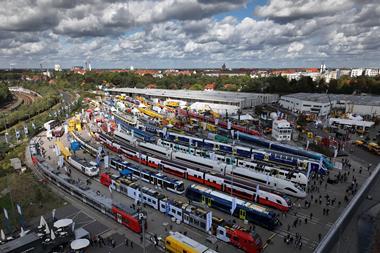
We invite all visitors to join us at the Linsinger outdoor exhibition area to experience the Railmaster firsthand and discuss how innovative rail milling solutions can contribute to more sustainable and efficient railway networks.
Explore the full rail milling portfolio at Linsinger.




No comments yet