

Ahead of Innotrans 2026, Léon Soulier, CEO Turnkey Business Unit at Siemens Mobility demonstrates how Siemens Mobility’s turnkey approach stands out in delivering complex rail projects.
What is Siemens Mobility’s turnkey approach and what differentiates it in today’s rail market?
Today’s rail projects are larger, more interconnected, and more complex than ever before. Customers are no longer looking for individual products. They need a partner that can bring together multiple technologies, stakeholders and interfaces while ensuring seamless system integration and performance.
This is where Siemens Mobility’s turnkey approach stands out. We take full end-to-end responsibility, combining project management, rail technologies, and E&M system integration under one roof. By integrating rolling stock, signalling, electrification, communications and service from the outset, we provide customers with a single point of accountability throughout the project lifecycle. This reduces complexity, minimises interfaces between contractors, and helps achieve more predictable project outcomes. With over 50 successful turnkey projects worldwide, we deliver proven expertise to tackle even the most complex rail challenges.
How does technology enable successful delivery of complex rail projects?
Technology is a key enabler for delivering complex rail projects successfully. We use it not only to improve the railway itself, but also to manage project complexity by optimising planning, design and execution.
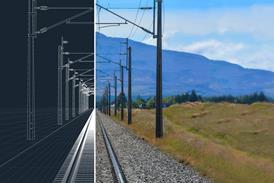
A strong example is our digital twin approach. Using Building Information Modeling (BIM), we create a digital twin of the rail system, enabling project teams to plan, coordinate and optimise projects virtually before implementation. Potential issues, design conflicts and interface challenges can be identified and resolved in the digital model before they become costly problems on site.
In one project, civil, track and system designs were coordinated virtually before breaking ground, enabling teams to identify and resolve more than 17,000 clashes before construction started – significantly reducing risk, rework and delays.
Beyond virtual planning, our digital twin approach also helps us connect and structure large volumes of project information. Through our self-developed Project Insight Board (PIB), a digital twin for project management, we integrate multiple data sources into a connected project data ecosystem, providing a holistic view of dependencies, risks, and project performance.
With agentic AI embedded in the PIB, we further transform connected project data into actionable insights and advanced root cause analysis. This helps teams understand not only what is happening, but why it is happening and what actions should be considered next.
Can you give us some recent examples of how Siemens Mobility is bringing complex turnkey rail projects to life?
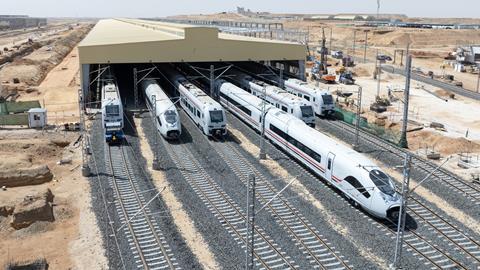
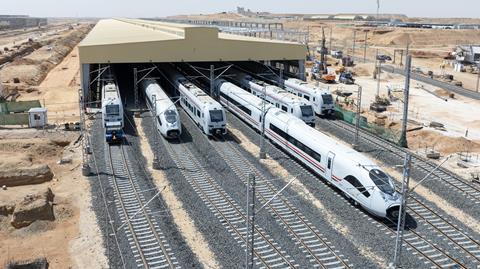
In Egypt, we recently reached another important milestone in one of the world’s largest high-speed rail projects. Together with our partners, we are delivering a 2,000km rail network that will become the world’s sixth-largest high-speed rail system. Most recently, all rolling stock types entered the delivery phase, with 14 Desiro trains, seven Velaro trains, four Vectron locomotives already delivered to Cairo, while additional vehicles are already on their way. We also signed a strategic agreement with the National Authority for Tunnels to support the network’s expansion toward Alexandria.
In Australia, the first Inspiro train arrived in Sydney for the Sydney Metro – Western Sydney Airport line. The fully automated trains will operate on the new 23km line connecting St Marys with the future Western Sydney International Airport, supporting reliable and sustainable mobility for a fast-growing region.
In India, the new Pune metro line is set to open soon. The new 23.3km corridor will connect one of India’s leading IT and business hubs with the city centre, providing a fast and reliable alternative to road transport. The project is expected to reduce travel times by around 50% while supporting more sustainable urban mobility.
About the interviewee
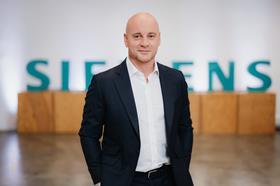
Léon Soulier is CEO of Siemens Mobility’s Turnkey Business Unit and Middle East & Africa Region. With more than 20 years of international leadership experience, he has held senior roles across Europe, Asia, and the Middle East. He leads complex rail projects worldwide and holds degrees from Delft University of Technology and ESMT Berlin.

No comments yet