
German infrastructure manager DB InfraGO has set out an adapted diversion plan for long-distance, local and freight services on the Hannover to Berlin corridor, after delays to the electrification of the Lehrter Stammbahn line pushed back its availability as a diversion route.
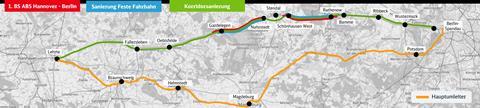
DB InfraGO has presented initial details of an adapted construction and transport concept for the Hannover to Berlin corridor, after delays to the electrification of the Lehrter Stammbahn line meant it will not be available as a diversion route from December 2026 as originally planned.
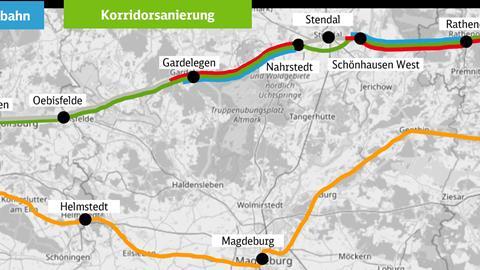
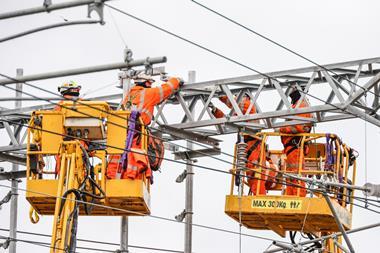
Extensive construction work will begin on the east-west axis between Hannover and Berlin on 2 October, covering renewal of the slab track on the high-speed line east and west of Stendal, continued electrification of the parallel Lehrter Stammbahn line, and corridor renovation in the Lehrte to Berlin section. Because the electrification will not now be completed until December 2027, trains will be largely unable to run on either line during the construction period, requiring the revised diversion arrangements.
Renewal programme covers switches, track and stations
By December 2027, DB InfraGO plans to have renewed more than 214 switches, approximately 357 kilometres of track, 100 kilometres of overhead lines and 13 kilometres of noise barriers. Twenty seven stations will be modernised, with some made accessible, and six signal boxes will undergo a complete overhaul. At 227 kilometres, the route is the second longest axis after the Hamburg to Berlin corridor, where infrastructure is also being renewed. DB InfraGO said the aim is to modernise the heavily used network and improve punctuality, reliability and efficiency in the long term.
DB InfraGO presented a draft of the updated transport concept to railway companies and transport authorities, and is currently finalising it with all stakeholders ahead of the timetable change in mid-December 2026. Services for local and long-distance transport up to that point have already been incorporated into the timetable and are available via information systems.
From the December 2026 timetable change, three long-distance trains per direction will run every two hours, along with additional individual services between Hannover and Berlin, diverted via Braunschweig and Magdeburg. Both towns will retain hourly connections to the long-distance network, with Magdeburg receiving more long-distance stops than usual during the construction period. Journey times between Hannover and Berlin will increase by approximately 80 minutes, and options for additional stops in Stendal and Wolfsburg remain under review. DB InfraGO will prepare the diversion route via Braunschweig and Magdeburg for the extra traffic through a maintenance programme running until October 2026.
For local public transport, DB InfraGO said a reliable basic service will be maintained throughout construction, with replacement bus services planned where trains cannot run and local trains routed as close as possible to closed sections of track. A detailed local transport concept for the period from the December 2026 timetable change is being developed with the relevant authorities.
Freight services will also be diverted via Braunschweig and Magdeburg during the corridor renovation. A second diversion route via Halle and Eichenberg, currently being modernised and expanded, will become available for freight trains by the end of January 2027 at the latest. DB InfraGO is postponing a second construction phase originally planned to begin on that route in summer 2027, a move it said will create additional capacity in 2027, particularly for rail freight and charter services.




No comments yet