
Rail Baltica Lithuania has completed continuous welded rail on a nearly 9km section of the new European standard gauge double-track railway, marking a key construction milestone as the project moves towards turnout system installation.
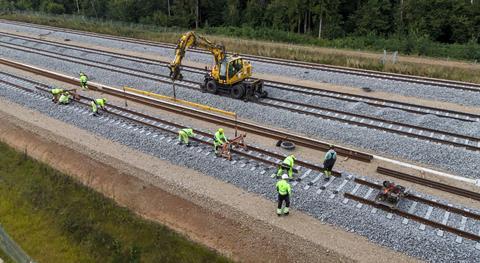
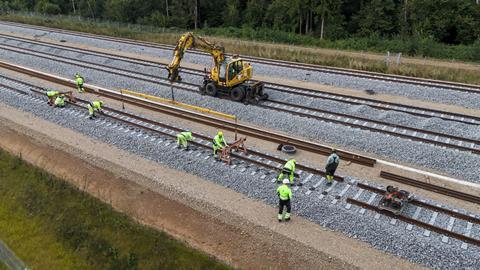
One of the most important stages of track superstructure construction has been completed on a nearly nine kilometre section of the new European standard gauge Rail Baltica double-track railway in Lithuania, with rails flash welded into continuous welded rail. The project will now move on to the next stage, the installation of turnout systems.
Mindaugas Ivanavicius, Chief Officer of Rail Baltica Lithuania, said: “Each completed stage of construction brings us closer to our primary goal of delivering a modern European rail connection. Today, it is increasingly important to speak not only about plans but also about tangible results already visible on construction sites. This steady progress strengthens confidence in the project and lays a solid foundation for its subsequent implementation stages.”
CWR technology supports high-speed operation
Continuous welded rail technology is intended to ensure track stability, long-term durability and reliable operation. According to Rail Baltica Lithuania, this is particularly important for the line, which is designed for passenger train speeds of up to 249 km/h, with a high-quality track structure considered a key prerequisite for safe and comfortable operations in the future.
To meet quality standards, every rail weld is independently inspected and assessed, with engineering and technical supervision specialists verifying compliance with technical requirements and the standards applicable to high-speed railway infrastructure.
Track superstructure construction on the section is being carried out by joint venture partners Leonhard Weiss International, of Germany, and Leonhard Weiss OU, of Estonia. The turnout systems for the section are currently being manufactured by voestalpine Railway Systems Lietuva.
Construction and design activities are continuing across other Rail Baltica sections in Lithuania, including modernisation of the section between the Polish-Lithuanian border and Kaunas, development of the signalling subsystem for that route, design of individual point infrastructure projects, and procurement procedures for future project activities.

![Artists impression of an HS2 train from the side[2]](https://d2t7mfz1xjpi04.cloudfront.net/Pictures/380x253/1/1/2/3112_Artists-impression-of-an-HS2-train-from-the-side2.jpeg)


No comments yet