
Speakers at a European Parliament event say the absence of a successor to Europe’s Rail Joint Undertaking could affect jobs, FRMCS deployment and competitiveness, while the rail supply industry has offered to match up to €3bn of funding.
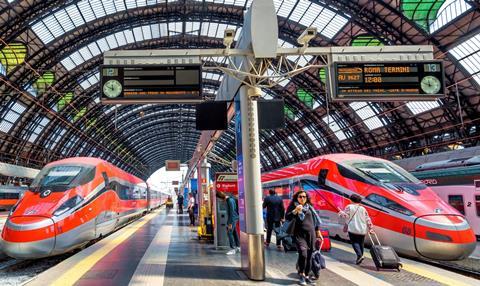
Speakers at a High-Level Event at the European Parliament have warned that Europe could face rail industry job losses and ageing network technology without a successor to Europe’s Rail Joint Undertaking in the next EU budget.
Policymakers and industry representatives argued that commuters, networks and rail workers would lose out without a new public-private research partnership between the EU and the rail sector. Members of the European Parliament Sophia Kircher and Christian Ehler (both EPP) joined UNIFE Director General Enno Wiebe.
Competitiveness and signalling at stake
Participants warned that, without joint research investment and sector-wide coordination, Europe’s rail supply industry could begin a decline similar to that of the EU automotive sector in the early 2010s, as global competitors from China now spend at least three times as much on research and innovation as Europe’s biggest rail suppliers and train builders.
Wiebe said: “With significant other pressures on the industry such as regulatory burdens and being locked out of nearly half the world’s rail markets, we need a successor to Europe’s Rail Joint Undertaking to stay competitive.”
Unveiled in 2021, Europe’s Rail Joint Undertaking has focused on technologies including Digital Automatic Coupling and the Future Railway Mobile Communication System (FRMCS), which is being fine-tuned through research programmes for rollout in the next decade as a solution to ageing signalling on Europe’s busiest lines.
Speakers warned that, without a successor, the transition from 2G technology to future radio-based communication could be slowed, become more expensive or be stopped. They argued that high-risk foreign suppliers could gain advantage in the European market, creating a major cybersecurity risk, on top of a failure to modernise networks and weakening competitiveness in one of the last industries where Europe retains genuine global industrial leadership.
He added: “Without a successor programme, we go back to the old days of no-coordination between EU Member States, industry, operators and policymakers. How can we build, optimise, innovate and roll-out a shared signalling system for Europe, let alone other rail solutions, if everyone isn’t working together?”
With significant other pressures on the industry such as regulatory burdens and being locked out of nearly half the world’s rail markets, we need a successor to Europe’s Rail Joint Undertaking to stay competitive.”
Industry offers to match €3bn funding
The European rail supply industry has said it is ready to commit and match funds of up to €3bn in a future research programme under Horizon Europe in the next EU budget. Supporters say the programme is central to technologies ranging from satellite use to climate resilience and lower deployment costs.
The rail supply industry employs 650,000 people, including construction, and supports other supply chains across Europe.
Kircher said: “If we want Europe’s rail industry to remain a global leader and if we want rail to regain momentum in modal share, we need to invest in research and innovation today.”
She called for a dedicated standalone Rail Joint Undertaking in the EU budget for 2028-2034.




No comments yet