

GRR explains: ATO over ETCS has a European specification, but how railways operate it is still largely a national decision.
The Dutch operator NS has described an automatic train operation (ATO) prototype that ran on ATB, the Dutch national train protection system, between Hengelo and Enschede. The prototype had previously been tested over both the European Train Control System (ETCS) and ATB. The account, a Europe’s Rail deliverable revised on 7 July 2026, shows a railway reaching the edge of the European specification. The European Union Agency for Railways (ERA) states in its operational scenarios that ATO combined with a Class B train protection system, meaning a legacy national system, is not in scope. NS also found no trackside ATO and no traffic management system offered by the infrastructure manager, so it built its own. It was a demonstrator, not a service.
That edge matters because ATO over ETCS does have a European specification. The Control-Command and Signalling Technical Specification for Interoperability (CCS TSI) includes the mandatory ATO specifications for Grade of Automation 1 and 2 (GoA1 and GoA2), adopted as Commission Implementing Regulation (EU) 2023/1695 on 10 August 2023. Yet UNISIG, the signalling committee of the supplier association UNIFE, wrote in April 2024: “Unfortunately, also ATO GoA1 and 2 operation is not standardised.” Anyone writing an ATO requirement today must decide which parts to take from the specification, which to define alone and who signs off the difference.
Unfortunately, also ATO GoA1 and 2 operation is not standardised
UNISIG, the UNIFE signalling committee, position paper, April 2024
First, the terms. ERA describes ATO, or automatic train operation, as the subsystem that performs some or all of automatic speed regulation, accurate stopping, door opening and closing and performance level regulation. ETCS is the European automatic train protection system. The European Commission says it continuously ensures that the train does not exceed the safe speed and distance. The European Rail Traffic Management System (ERTMS) is the wider package, which the Commission’s FAQ describes as made up of ETCS, railway mobile radio and ATO. ATO over ETCS therefore means ATO working with ETCS, which provides the train protection.
CBTC, communications-based train control, is applied mainly on light rail and urban mass transit, according to a peer-reviewed review of the two systems. ETCS is used on heavy railways.
Is ETCS used in the UK? In Great Britain, yes. The National Technical Specification Notices that replaced the EU TSIs on 1 January 2021 apply there. Network Rail says the 08:05 Great Northern service to Moorgate on 31 August 2026 was the first passenger train to use ETCS in-cab signalling on the East Coast Main Line. It left Welwyn Garden City under ETCS Level 2. Network Rail’s account does not mention ATO.
The technology, explained
ATO takes over automatic speed regulation and accurate stopping, along with other tasks normally left to a driver or train attendant. ETCS continues to supervise safe speed and distance. ERA’s documents are plain that ATO is not a safety critical system, so safety requirements sit with ETCS and other systems. In GoA1 and GoA2 the supervision of the operation remains part of the train driver’s responsibility. Door control shows the split. ATO commands door opening and closing, but an external safety system authorises it. The specifications are agreed for GoA1 and GoA2 only. GoA1 is treated as a degraded fall-back, and GoA3 and GoA4 are included for information.
What ATO over ETCS fixes and what it leaves optional
ERA’s list of mandatory specifications for the CCS TSI names the set ATO Baseline 1 Release 1, used with ETCS Baseline 4 Release 1. SUBSET-125 sets the ERTMS/ATO system requirements. SUBSET-126 defines the interface between the on-board and trackside ATO systems. SUBSET-148 covers the transport and security layers of that interface. SUBSET-130 defines the interface between the ATO on-board system and the ETCS on-board unit.
Radio is covered too. The TSI has separate points on data communication for ATO over the Global System for Mobile Communications – Railway (GSM-R) and over the Future Railway Mobile Communication System (FRMCS).
Two technical points limit where it can run. On the vehicle, ERA’s application guide sets a condition. To operate in ATO mode on a line with trackside ATO Baseline 1, the ETCS on-board unit must support system version 2.2 or higher, as defined in Baseline 4 Release 1. A vehicle on an older ETCS version does not simply gain ATO. On the trackside, no mandatory change to ETCS trackside is needed to add ATO. ERA says trackside ATO can sit on ETCS trackside system versions 1.0 to 2.1.
Testing followed. ERA recommended in December 2024 that the TSI be amended to cover test requirements for ETCS Baseline 4 and ATO Baseline 1. Commission Implementing Regulation (EU) 2026/693 did that. The Commission adopted it on 19 March 2026, it was published on 15 April and it entered into force on 5 May 2026. ERA says it adds reference documents for testing, including SUBSET-151 on ATO testing, and clarifies the transition rules for projects already under way.
What the specification does not do is oblige anyone to deploy ATO on a given line. ERA’s application guide lists ATO on-board among the optional functions, with conditions. It says an infrastructure manager may mandate ATO on-board through the transition rules in Appendix B. It also says that implementing trackside ATO can create new mandatory on-board requirements once the infrastructure manager notifies it in the Register of Infrastructure or the Network Statement.
The practical effect is that two railways can comply with the same TSI and still offer very different things. One may notify ATO on a corridor and equip it. Another may not. An operator running vehicles across both has to ask the question line by line.
The prize is capacity. Europe’s Rail says ATO over ETCS is designed for use across the European network and could help operators increase capacity and optimise existing networks. It adds that a few railway projects have already reached GoA2, and that the full potential will probably need GoA3 or GoA4.
By the numbers
• 10 August 2023: adoption of Implementing Regulation (EU) 2023/1695, the CCS TSI that includes the mandatory ATO specifications for GoA1 and GoA2
• 28 September 2023: entry into force of the amended Operation and Traffic Management TSI (OPE TSI)
• GoA1 and GoA2: the two grades of automation covered by the ATO specifications and operational scenarios. GoA3 and GoA4 are for information only
• 5 May 2026: entry into force of the amendment adding ATO Baseline 1 testing provisions, including SUBSET-151
• At least 100: substantially different signalling requirement baselines in Europe, UNISIG says. Its illustration assumes 25 infrastructure managers with four signalling system versions each
Where operating rules and national systems take over
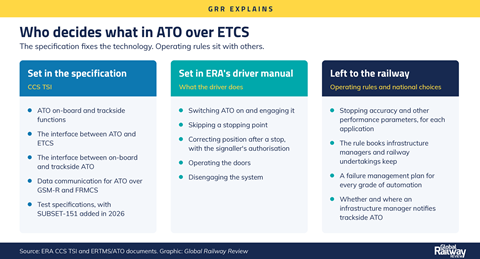
ERA’s operational documents for ATO draw the boundary themselves. The ERTMS/ATO operational scenarios cover GoA1 and GoA2 only. They state that their purpose includes helping operating rules and procedures to be developed, which is not the same as setting them. They flag some behaviours as dependent on those rules. After a train overshoots a stopping point beyond the rollback tolerance, the driver has to take manual action under the operational rules. The text adds a caveat: “in some cases manual jogging backwards may be allowed depending on the operational rules.” The companion operational principles say railways specify performance parameters, including stopping accuracy, for each application. They require a failure management plan for every grade of automation.
The CCS TSI hands the subject on. The rules for operating a railway service with ETCS, ATO and railway mobile radio are specified, it says, in the Operation and Traffic Management TSI (OPE TSI). ERA’s ERTMS driver manual sets out what a driver does with ATO. The driver switches the ATO selector on and engages the system once it shows ready. The driver skips a stopping point when the timetable requires it. After a stop, the driver may move the train manually to correct its position, but only with the signaller’s authorisation and after notifying passengers. The driver operates the doors when the display invites it and can disengage the system. The OPE TSI also requires infrastructure managers and railway undertakings to keep their own rule books, which must cover signalling and control-command systems.
That covers the driver’s handling of the system. It does not amount to a harmonised operating concept. ERA said as much in 2024, when it described the System Pillar work as deriving harmonised operational processes beyond the current scope of the OPE TSI. UNISIG makes the commercial case. Because operational requirements are national to a large extent, it says, ATO variants arrive on top of the signalling variants Europe already has. ETCS, interlocking, ATO and Digital Automatic Coupling (DAC) requirements, it warns, will be defined at national level independently from each other unless operations are harmonised. UNISIG speaks for the supply industry, which has an interest in fewer variants. Europe’s Rail describes the same problem. Its 2025–26 work programme says differences in operation are one of the key root causes of complexity. Its draft 2026 programme says that without harmonisation national operational rules would keep driving customisation.
The Dutch case shows what that looks like in practice. The NS demonstrator combined remote train operation with ATO-GoA2 for stabling and for bringing a train to the station. ATB has no balises, so ATO needed another positioning source. NS used a proprietary solution that combines satellite positioning with virtual balise positioning. The trackside system did not have the status of non-centralised signals, so it could not pass that status to ATO. Signal recognition therefore needed supervision by a driver, who in this study was the remote driver. NS also found “no ATO-TS nor Traffic Management System (TMS) offered by the infrastructure manager” and built the trackside system itself from components of its driver advisory system. The TSI says ATO information should appear on the ETCS driver display. NS could not change the ETCS on-board unit because of derogation restrictions, so it added a separate ATO display. The report is careful about scope. All tests ran in daylight and good weather, so it draws no conclusions for night or poor visibility. Door closing was not implemented, and degraded modes were out of scope.
The sector’s answer is a harmonised rulebook rather than a longer specification. Within Europe’s Rail, an operational harmonisation team in the System Pillar works on a harmonised operational concept, rules and processes for ETCS Level 2, which also covers ATO GoA1 and GoA2. Its work programme set a target of October 2025 for the first rulebook chapters for train drivers, signallers, track workers and shunting staff. The draft 2026 programme lists further releases dated 15 April and 15 October 2026. It describes the rulebooks as a recommended amendment to the OPE TSI and says the work includes preparing change requests where necessary. Europe’s Rail’s Multiannual Work Programme says the result will be introduced in three steps, starting with a TSI guideline for 2027 on using ETCS Level 2 with ATO. Until the OPE TSI is amended, the rulebooks remain recommendations.
The decision this forces is one of timing. A railway can write its own ATO operating concept now and carry the cost of aligning it later. Or it can wait for harmonised rules and defer the capacity gains. A railway already part-way through an ETCS Level 2 migration has the easier call, because the harmonised work is built around ETCS Level 2 operation.
How it compares
Set out in the specification: ATO on-board and trackside functions, the interface between ATO and ETCS, the interface between on-board and trackside ATO, data communication for ATO over GSM-R and FRMCS, and test specifications, with SUBSET-151 added in 2026.
Set out in ERA’s driver manual: switching ATO on, engaging it, skipping a stopping point, correcting position after a stop with the signaller’s authorisation, operating doors and disengaging.
Left to the railway: stopping accuracy and other performance parameters, which railways specify for each application, and the rule books that infrastructure managers and railway undertakings keep.
Left to the infrastructure manager: whether and where to notify trackside ATO, which can create new on-board requirements.
Outside scope: ATO with a Class B train protection system. GoA3 and GoA4 are included for information only.
As of 18 November 2026 the position is this. The technical specification for ATO GoA1 and GoA2 is in force, and a testing amendment took effect on 5 May 2026. The English text of the OPE TSI dates from 2023, and GRR found no amendment covering a wider ATO operating concept. GRR’s interview with Europe’s Rail’s executive director reports that the System Pillar has already defined harmonised operational rules. Europe’s Rail’s own work programme calls the rulebooks a recommended amendment, so they remain recommendations until the TSI changes, and its Multiannual Work Programme points to 2027 for the first formal step. The gap resembles the one GRR examined in the dispute over ETCS compatibility checks, where GRR found no binding referee.
Three questions follow for anyone with an ATO requirement on their desk. Has the infrastructure manager notified ATO on the line? Which operating rules cover overshoots and failures? Who approves them? The answers, not the specification, decide how much of the work a supplier contract actually covers.









No comments yet