
Etihad Rail’s phased approach to freight, passenger and high-speed rail is creating a resilient railway designed to support the UAE’s long-term economic ambitions.
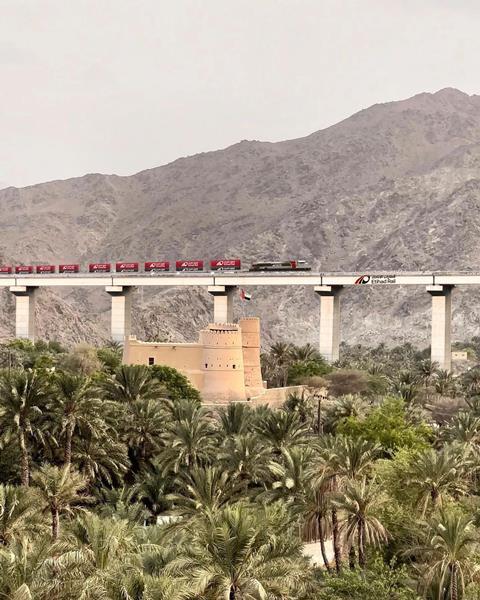
When the UAE began constructing its national railway, it was not modernising an ageing system. It was building one from scratch.
There were no legacy corridors to upgrade. No historic passenger routes to revitalise. No existing institutional railway culture to inherit.
Instead, the country faced a strategic question: how do you future-proof a logistics-dependent economy in a region defined by long distances, extreme climate conditions, and fast-growing trade flows?
The answer was Etihad Rail – a national railway designed to serve both freight and passenger mobility, and to act as a structural backbone for long-term economic integration.
Why a national railway was necessary
For decades, road freight carried the UAE’s economic expansion. Trucks connected ports to inland industrial zones and construction corridors. That model supported rapid development, but it was not built for sustained scale.
As industrial output increased and trade volumes expanded, structural pressures became clear and included congestion along major intercity corridors, rising road maintenance costs, exposure to fuel and driver market volatility, increasing demand for bulk and high-volume cargo movement.
The UAE’s economic model – heavily integrated with global trade and regional logistics – required a system capable of moving large volumes predictably, efficiently and sustainably. Rail offered that structural solution.
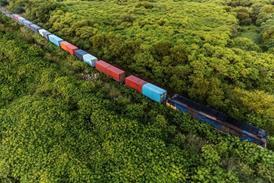
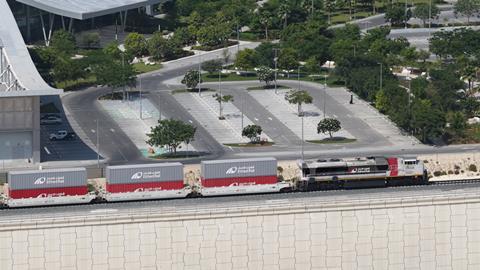
The freight network now spans approximately 900km, linking major ports, industrial zones and logistics hubs. Each freight train can carry the equivalent of up to 300 heavy trucks, reducing pressure on highways while improving schedule certainty for industrial operators.
In global terms, the rationale mirrors that seen in Australia’s Pilbara heavy-haul corridors or North America’s Class I freight backbone: scale and reliability drive competitiveness.
But, the UAE added a second strategic dimension – passenger mobility.
As inter-emirate travel volumes grew, the need for a congestion-free, predictable alternative between major urban centres became increasingly evident. Passenger rail is now being introduced in phases, beginning with services between Abu Dhabi, Dubai, and Fujairah, which launch this year.
The freight-first foundation has provided a safety and operational blueprint for passenger expansion – a sequencing model increasingly discussed in rail strategy circles.
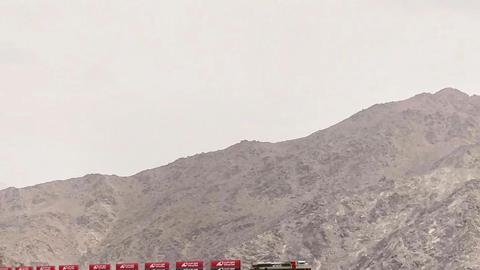
In the Gulf, the railway was not inherited. It has been conceived, engineered and built from the desert up.”
Engineering for climate resilience
Building a railway in the Gulf region requires solutions that differ from temperate geographies.
Extreme heat, shifting desert sands and saline coastal environments pose engineering challenges that influence everything from materials selection to maintenance regimes.
Etihad Rail’s infrastructure has been developed with climate resilience embedded at system level: ballast and track design adapted to high-temperature tolerance, continuous monitoring of sand accumulation across exposed sections, agricultural buffer pilots (including Blue Panicum planting) to mitigate wind-blown sand drift, corrosion-resistant materials for coastal environments.
Rather than retrofitting resilience, it has been designed into the network from inception – a key advantage of building a system without legacy constraints.
As climate adaptation becomes a central theme in global rail investment, desert network experience is attracting growing international interest.
AI, automation and predictive operations
Technology is in the process of being integrated across both freight and passenger planning from the early stages.
Etihad Rail is exploring AI-enabled inspection systems to monitor track conditions in real time, which would allow predictive maintenance rather than reactive repair. Alongside this, is the potential for camera-based systems to assess track geometry and infrastructure integrity without requiring network shutdowns.
Other areas of development include onboard IoT sensors, which could be used to monitor vibration and acoustic patterns, thereby enabling early detection of anomalies and improved ride quality for passenger services.
Etihad Rail is also piloting advanced technologies such as ferromagnetic levitation systems in collaboration with European partners, demonstrating willingness to explore next generation mobility solutions, even while focusing on proven core operations.
The overarching strategy reflects a broader shift in global rail thinking: digitalisation is not an enhancement layer, but a central operating philosophy.
The power of partnership
Importantly, the UAE’s railway is not being developed in isolation. A network of international and regional partners underpins the project’s technical and operational capabilities.
These include:
- Keolis – supporting passenger operations and service planning
- L&T Technology Services – delivering AI-driven inspection capabilities
- Silal – collaborating on environmental mitigation pilots
- Technology innovators across Europe and Asia contributing to advanced systems trials.
This hybrid model – combining global rail expertise with domestic capacity building – aligns with the UAE’s wider infrastructure strategy.
At the same time, the establishment of the Etihad Rail Innovation Centre (ERIC), unveiled at Global Rail 2025, signals an intent to create a regional hub for rail research and applied technology development.
Global studies consistently show that rail investment generates multiplier effects beyond direct transport benefits.”
As global rail markets increasingly compete for talent and intellectual capital, this ecosystem approach may prove as significant as the physical infrastructure itself.
Expanding routes and regional integration
Freight operations currently connect major industrial and logistics centres across the Emirates. Future development phases include deeper integration into the GCC network, strengthening regional connectivity.
Passenger services are being introduced in stages, beginning with Abu Dhabi–Dubai connectivity and expanding to additional emirates over time.
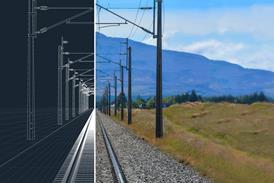
Looking further ahead, high-speed rail is planned to reduce travel time between Abu Dhabi and Dubai to approximately 30 minutes, operating on a fully electrified network.
Together, conventional passenger rail, high-speed services and freight form a layered national system – one that mirrors the integrated models seen in Europe and East Asia, but adapted to Gulf geography.
Economic multiplier effects
Global studies consistently show that rail investment generates multiplier effects beyond direct transport benefits.
Lower logistics costs improve export competitiveness. Improved labour mobility expands effective labour markets. Transit-oriented development stimulates real estate and commercial activity around stations.
Oxford Economics analysis suggests rail infrastructure investment often delivers several multiples of economic output relative to capital expenditure, particularly in logistics-intensive economies.
For the UAE, sectors likely to benefit most include construction and building materials, petrochemicals and energy, metals and heavy manufacturing, ports and re-export logistics, tourism and business travel.
In this context, rail becomes a true productivity platform.
A case study in strategic sequencing
Perhaps the most distinctive element of the UAE’s approach is sequencing. Freight first. Operational discipline embedded early. Passenger services introduced in calibrated phases. High-speed rail layered on top. This progression reflects a long-term view of national infrastructure development, and one that prioritises system integrity over speed of expansion.
As rail markets globally confront climate risk, urban congestion and supply chain volatility, the UAE’s experience offers an instructive case study: what happens when a country designs a railway not to solve yesterday’s problems, but tomorrow’s.
No comments yet