
With operators under pressure to expand capacity at speed, refurbishment has become a critical lever for keeping fleets moving. David Ovsjannikov, Sales Director at 4RAIL, explains how flexibility, technical expertise and fast turnaround are reshaping rolling stock modernisation across Europe.
What are the biggest challenges currently facing railway operators when it comes to modernising their rolling stock?
One of the biggest challenges today is time. Operators are often under pressure to complete projects very quickly. When opportunities to expand arise, it creates a chain reaction: operators need additional coaches in service immediately, but they may not have enough spare vehicles or readily available coaches in suitable condition. As a result, they need to source coaches and refurbish them into service-ready condition as quickly as possible.
Naturally, operators want minimal downtime and fully operational coaches on their new lines without delay. At 4RAIL, we work closely with customers to meet these demanding timelines through flexibility, clear communication, and practical solutions.
Refurbished coaches can be delivered much faster, which is increasingly important for operators facing immediate capacity needs.”
How does 4RAIL help operators extend the life of their train fleets through refurbishment and modernisation?
At 4RAIL, we focus on three key areas when modernising coaches: interior, exterior and technical components.
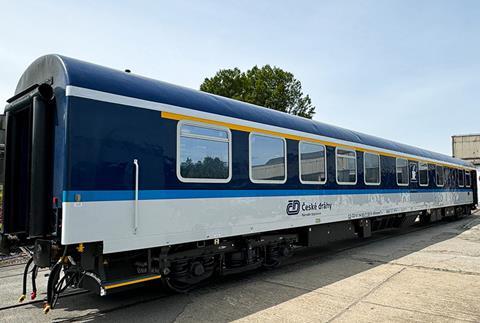
For the interior, we transform outdated coaches to meet modern design standards and customer expectations, enhancing both comfort and accessibility. This includes replacing flooring, refurbishing or exchanging seats, updating interior walls, renovating bathrooms, upgrading Wi-Fi systems, and adding pictograms and interior branding – all according to the customer’s specifications or design manual.
For the exterior, coaches are sandblasted – when needed down to bare metal – to uncover and repair any corrosion. A new painting system is then applied to ensure durability and long-term protection. Damaged or fogged windows are replaced, along with all seals around windows and doors to prevent water ingress and future corrosion. Exterior branding is also applied as required.
On the technical side, each coach undergoes an initial high-voltage test to identify potential defects in key components such as HVAC, entrance doors, toilets, and the electronic control panel. We carry out revisions according to customer specifications to extend the operational cycle. A final high-voltage test, along with a brake test, ensures that all systems are fully functional and safe before delivery.
Customer expectations are constantly evolving. What do operators value most when choosing a refurbishment partner today?
Today, operators prioritise flexibility, reliability and quality. They are under constant pressure to refurbish coaches quickly and return them to service, making it critical to meet deadlines without compromising standards.
Equally important is trust. Refurbishment projects can encounter unexpected issues, and operators need a partner who will collaborate closely to resolve problems and ensure coaches are delivered on time and in excellent condition. A dependable refurbishment partner combines technical expertise with a proactive, solution-oriented approach, giving operators confidence that their fleet will be ready when it’s needed.
Large-scale refurbishment projects require strong coordination. How does 4RAIL manage complex international projects?
At 4RAIL, our strength is our experienced team. From project management to technical and quality departments, every member brings extensive experience leading English-speaking international projects.
Communication and transparency are key to success. We approach large-scale projects as true partnerships, with both sides working toward the same outcome. Thorough preparation – from defining the project scope to specifying all required handover documentation – ensures everyone knows what to expect.
Challenges are inevitable in large projects, but careful planning and constant communication help us minimise risks and keep everything on track.
Refurbishment is often seen as a cost-effective alternative to purchasing new rolling stock. Why are more operators choosing refurbishment today?
Refurbishment is a cost-effective alternative to purchasing new rolling stock because it is generally cheaper than buying a new train from an OEM. Refurbished coaches can also be delivered much faster, which is increasingly important for operators facing immediate capacity needs.
We are seeing a strong trend of operators purchasing second-hand coaches in very good condition that still have many years of operational life. These projects often require only light refurbishment – mainly to align coaches with the company’s branding and standards – making the process faster and less intensive. Overall, refurbishment provides a quicker, more flexible solution for operators looking to expand their fleet efficiently while controlling costs.
We are seeing a strong trend of operators purchasing second-hand coaches in very good condition that still have many years of operational life.”
How do you see the rail industry changing in the next 5 to 10 years , and how can refurbishment help operators maintain reliability and minimise downtime?
In the next 5 to 10 years, the rail industry will likely be shaped by growing pressure to improve sustainability, maintain fleet availability, and manage costs more efficiently. Refurbishment will continue to be an important part of the market. It offers operators a cost-effective and sustainable way to extend the life of existing and second-hand vehicles, improve reliability, and reduce downtime.
We are already seeing this trend in the strong demand for second-hand RIC coaches such as Bpmmz, Bpmmbz, and Bvmmsz. With our experience in these vehicle types, we are well positioned to support operators with efficient refurbishment solutions. Looking ahead, as OEMs continue to introduce new standards and technologies, refurbishment providers must adapt in parallel. At 4RAIL, we are continuously investing in our facilities and capabilities to ensure we remain competitive and deliver long-term value to our customers.