


The transition from GSM-R to the Future Railway Mobile Communication System (FRMCS) represents a key enabler for the digital transformation of railway operations and the continued evolution of train control systems. SBB’s Massimiliano Rizzato explains the Swiss Federal Railways approach.

For Swiss Federal Railways (SBB), this transition represents the gradual transformation of a mission-critical communication ecosystem that has supported railway operations reliably for many years.
As both an infrastructure manager and a railway undertaking, SBB relies directly on operational communication systems for the safe and efficient management of train operations. It also acts as system authority in Switzerland for key railway systems, contributing to the coherence and interoperability of communication systems across the national network.
For SBB, delivering a next-generation communication platform that supports operational services, ensures interoperability with European systems, and maintains safety and robustness requires careful architectural planning and technical validation.
From legacy communication to a digital platform
GSM-R has served as the backbone of operational railway communication across Europe for more than two decades. It has enabled operational voice communication, supported train control systems and ensured interoperability across national railway networks and international corridors.
During this time, the operational and technological environment of the railway system has evolved significantly. Increasing levels of automation, digital operational tools and the continuous development of ERTMS applications are generating new communication requirements.
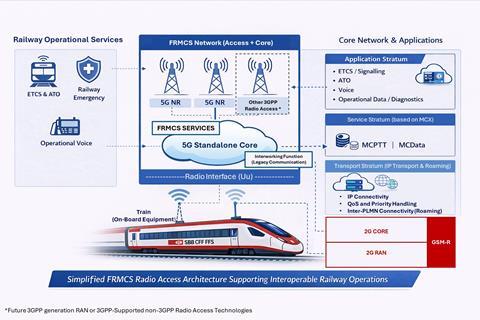
FRMCS has been designed to address these evolving needs. Based on modern mobile communication technologies, it provides a flexible platform capable of supporting both existing operational services and future digital railway applications.
For SBB, FRMCS is therefore considered a foundational element of the future railway communication architecture. At the same time, the transition from GSM-R must be carefully managed to ensure that existing railway operations remain fully supported throughout the migration period.
Managing the hybrid environment
One of the defining characteristics of the transition to FRMCS is the coexistence of legacy and next-generation communication technologies. For a considerable period, GSM-R and FRMCS will operate in parallel, requiring careful coordination to ensure trains, staff and traffic management systems can operate seamlessly without disruption.
From a system engineering perspective, this coexistence introduces several challenges: multiple communication technologies must operate simultaneously without interference, and operational services must remain fully reliable across the network. SBB therefore considers managing this hybrid environment a central aspect of its migration strategy. Effective planning must address radio architecture, operational integration, and system interaction to maintain continuity, safety and interoperability throughout the transition.
Designing the FRMCS radio network
The communication infrastructure operated by SBB supports multiple railway undertakings operating across the national network. The system architecture must therefore provide a consistent communication environment while accommodating the operational diversity of the railway system.
A first principle is the reuse of existing railway communication infrastructure wherever possible. Established radio sites represent an important asset and allow the introduction of new technologies while limiting the need for additional installations.
A second principle is the alignment of communication infrastructure with operational requirements. Railway lines differ in terms of operational characteristics, traffic density and service requirements.
A third principle is long-term scalability. The communication infrastructure introduced today must remain capable of supporting future railway services and technological developments.
Supporting the evolution of railway applications
Train control applications rely on reliable communication between trains and trackside systems. As railway signalling systems evolve, communication networks must provide increasingly robust and high-availability connectivity.
SBB’s role in this environment also extends to ensuring that communication systems deployed within the railway ecosystem remain technically coherent and interoperable. This includes supporting the evaluation and assessment of on-board communication equipment in the context of national regulatory frameworks and European interoperability requirements.
Such activities contribute to ensuring that communication systems deployed on railway vehicles remain compatible with the evolving operational communication infrastructure.
Learning through technical validation
In railway communication systems, technical validation under real operational conditions is essential.
Before large-scale deployment, communication technologies must be evaluated through pilot environments and controlled testing activities. These activities allow engineers to analyse radio propagation characteristics, system behaviour and the interaction between different communication technologies.
Testing is particularly important when evaluating coexistence scenarios between legacy communication systems and next-generation radio technologies.
Operational applications must also be validated within the new communication environment. Voice communication services, operational data exchange and other mission-critical services must operate seamlessly across the evolving communication architecture.
These validation activities provide valuable operational insights and help refine deployment strategies before large-scale implementation.
Ensuring European interoperability
Railway transport in Europe relies heavily on cross-border interoperability.
Trains operating along international corridors must be able to communicate seamlessly with national communication systems when crossing borders. This principle has historically guided GSM-R deployment and remains equally important for FRMCS.
SBB therefore places strong emphasis on maintaining alignment with European interoperability frameworks.
Close collaboration with European railway organisations, infrastructure managers and standardisation bodies helps ensure that national deployment approaches remain compatible with the broader European communication ecosystem.
Through this collaboration, the railway sector continues to develop common technical frameworks enabling interoperable railway communication across Europe.
Preparing the communication system of the future
The transition from GSM-R to FRMCS represents one of the most significant technological developments currently shaping the railway sector.
For SBB, the objective is to introduce this next-generation communication platform in a manner that supports the digital evolution of railway operations while maintaining the reliability and safety expected from railway infrastructure.
Achieving this objective requires a careful balance between technological innovation and operational stability.
Through architectural planning, technical validation, and cooperation with European partners, SBB is preparing the communication backbone for the next generation of railway operations.
FRMCS will form a key component of the future digital railway ecosystem, enabling new operational capabilities while preserving the reliability and interoperability that remain fundamental to railway transport.






No comments yet