
Senior ministers, industry leaders and Baltic stakeholders convene in Madrid to reinforce Rail Baltica’s strategic role in European connectivity, security and economic resilience – with a clear warning that delivery hinges on stable, long-term EU financing in the next Multiannual Financial Framework.
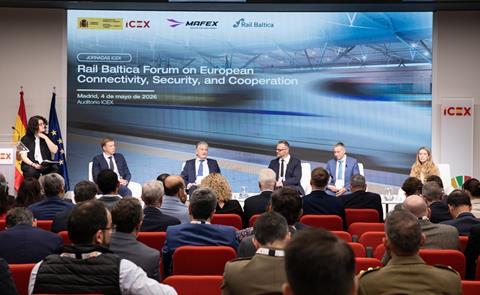
Approximately 200 representatives from Spain’s railway sector, public administration and senior delegations from the three Baltic states convened in Madrid for the Rail Baltica Forum on European Connectivity, Security and Cooperation, reinforcing the strategic importance of predictable, long-term financing for Europe’s integrated transport infrastructure.
The forum, organised by ICEX Spain Trade and Investment, MAFEX (Spanish Railway Industry Association), RB Rail AS and the embassies of Estonia, Latvia and Lithuania in Spain - with support from Spain’s Ministry for Transport and Sustainable Mobility - delivered a unified message: completing the Trans-European Transport Network (TEN-T) will require sustained commitment through the 2028–2034 EU Multiannual Financial Framework (MFF), particularly via an enhanced Connecting Europe Facility (CEF) and its Military Mobility envelope.
Strategic Infrastructure Demands Strategic Funding
Opening the forum, Spain’s Minister of Transport and Sustainable Mobility, Óscar Puente Santiago, described Rail Baltica as embodying the essence of European integration. “Rail Baltica is a project that gives meaning to the very concept of European integration. It encapsulates and embodies, on the one hand, the desire and the need for a more closely united European Union, with rail as the binding thread, and, on the other hand, the challenges, both major and minor, encountered in that process. I therefore wish to send a clear message of support for Rail Baltica as a flagship European project,” he stated.
Rail Baltica is a project that gives meaning to the very concept of European integration.”
Estonia’s Minister of Infrastructure, Kuldar Leis, emphasised the project’s dual role in enhancing economic competitiveness and security. “Rail Baltica is one of Europe’s most important infrastructure projects, directly linking the Baltic Sea region with Central and Southern Europe and improving the movement of people and goods across the continent. It strengthens the EU’s economic competitiveness and security, including through enhanced military mobility on NATO’s eastern flank. Therefore, completing the main line by 2030 is a shared objective of all Baltic states - stable and sufficient financing is essential to achieve this,” Leis said.
Industry Calls for Procurement Excellence and Supply Chain Resilience
Marko Kivila, CEO and Chairman of the Management Board of RB Rail AS, the joint venture responsible for delivering the 870km standard-gauge railway linking Tallinn, Riga, Kaunas and the Lithuanian-Polish border, highlighted the project’s pan-European supply chain. “As the joint venture delivering Rail Baltica, we see every day how this project is being built by Europe, for Europe. From design to construction, our supply chain already brings together partners from across the continent. To continue and accelerate works on the ground, we now need even more decisive action at the political level, sustained cross-country cooperation and continuity of financing,” Kivila stated.
Pedro Fortea, General Director of MAFEX, argued that infrastructure of Rail Baltica’s scale demands funding aligned with its strategic importance. He warned that only long-term predictability in instruments such as the Connecting Europe Facility and its Military Mobility envelope can provide industry with the confidence to invest, innovate and deliver. Fortea also called for procurement frameworks that prioritise technical excellence, cybersecurity, supply-chain resilience and strict adherence to European standards—elements he described as essential to ensuring a genuinely level playing field across the bloc.
Military Mobility and Dual-Use Infrastructure
Latvia’s Ambassador to Spain, Jānis Zlamets, underlined that the CEF, including its Military Mobility component, will serve as a cornerstone of EU transport financing in the next budget cycle and must remain both ambitious and adequately resourced. Lithuania’s Deputy Minister for Transport and Communications, Roderikas Žiobakas, framed Rail Baltica as not only a mobility upgrade but a strategic investment in Europe’s broader security and resilience, with international cooperation a prerequisite for successful delivery.
The forum’s emphasis on military mobility reflects growing recognition of transport infrastructure’s dual-use potential, particularly along NATO’s eastern flank, where Rail Baltica will provide standard-gauge connectivity compatible with the wider European network.
Spanish Expertise in Multi-Gauge Integration
Two panel discussions, moderated by Politico reporter Martina Sapio, brought together representatives from RB Rail AS, Spanish authorities, Rail Baltica national implementing bodies, ADIF, Renfe, MAFEX and defence experts. Discussions centred on financing and interoperability of European rail corridors, the strategic role of the Connecting Europe Facility and its Military Mobility component, and the growing involvement of Spanish industry across infrastructure, systems, rolling stock and multi-gauge integration.
Completing Europe’s integrated transport network will hinge on predictable, long-term funding in the 2028–2034 EU Multiannual Financial Framework.”
Spain’s operational experience spanning Iberian gauge (1,668mm), European standard gauge (1,435mm) and variable-gauge technologies was repeatedly cited as a competitive advantage. Vytautas Radzevičius of LTG Group highlighted that Rail Baltica is already drawing on a broad base of European partners, including Spanish firms, creating clear mutual value along the supply chain. He stressed that investment in the Baltic region translates into tangible economic returns for the EU as a whole.
Building European Partnerships
The forum concluded with business-to-business meetings between Rail Baltica management and Spanish companies, alongside a technical visit to Madrid-Chamartín Clara Campoamor Station hosted by ADIF, Spain’s railway infrastructure manager.
The event underscored the importance of cross-border collaboration in delivering major rail infrastructure projects and highlighted the mutual benefits of integrating Spanish railway expertise - particularly in signalling, electrification, rolling stock and gauge-changeable technology - into the Rail Baltica programme.
As the EU prepares its next Multiannual Financial Framework, the Madrid forum has reinforced the message that completing the Trans-European Transport Network will require not only political commitment but sustained, predictable funding mechanisms that enable industry to plan, invest and deliver infrastructure critical to Europe’s economic competitiveness, connectivity and security.



No comments yet