

Kontron Transportation explains how White Space enables GSM-R and FRMCS to coexist, supporting a gradual migration towards future 5G railway communications.

For railway operators, White Space enables a smooth migration from GSM-R to FRMCS by allowing both systems to coexist on existing spectrum and sites, while keeping mission critical services running. Kontron Transportation’s White Space innovation enables GSM-R and FRMCS to coexist during railway migration.
An interview with Laurent Pison, Technical Solution Officer and Thierry Aste, Product Line Manager at Kontron Transportation, provides further insight.
In a nutshell, what is White Space and why is it important for railway operators?
Laurent Pison: One of today’s key challenges is introducing FRMCS while keeping GSM-R fully operational. White Space is our in-house developed coexistence mechanism that enables GSM-R and standard FRMCS to operate on the same spectrum, channels and sites. This protects existing infrastructure and supports a smoother migration to future 5G networks. Actually, we are now preparing for a major project milestone: field validation with SNCF under the RACOM project.
What makes Kontron’s White Space approach technically unique?
Thierry Aste: What makes White Space unique is the combination of deep GSM-R expertise, 5G know-how, 3GPP standardisation knowledge, and mission-critical railway experience. Instead of avoiding same-spectrum coexistence, as many vendors do, we designed a safe and controlled way for GSM-R and FRMCS to share the same spectrum while protecting operational services. In practical terms, this means offering sufficient capacity at the cell edge to support railway operational needs while keeping GSM-R protected and unaffected.
Does White Space replace the need for a full FRMCS migration?
Thierry Aste: No. White Space is designed as a migration enabler, not as a long-term replacement for full 5G infrastructure. Operators will ultimately move to full FRMCS networks with 5G cores and radio equipment, but this transition will take time – especially due to the complexity and cost of upgrading on-board train systems. White Space helps bridge this period by allowing GSM-R and FRMCS to coexist safely and reliably, ensuring no impact at Train side.
What does it take to implement White Space for a customer?
Thierry Aste: The key principle is minimal impact on the existing GSM-R infrastructure, with no impact on new standard FRMCS on-board equipment. Operators can reuse their 2G sites and, in many cases, the same antennas, while adding a gNodeB at each location, adjusting power levels where needed, and ensuring connectivity back to the core network. While 1900 MHz is technically simpler, it propagates over much shorter distances than 900 MHz. For large networks, this can mean thousands of additional sites and significant extra costs. White Space avoids this by enabling FRMCS in the 900 MHz band without requiring new spectrum, large-scale site deployment, or disruption to GSM-R operations in non-dense environments.
What does this mean for operators planning their FRMCS migration?
Laurent Pison: It gives operators the flexibility they need for a gradual FRMCS migration. Since not all trains, regions, or networks will be ready at the same time, GSM-R and FRMCS will need to coexist for many years. White Space protects existing infrastructure, reduces the need for costly new site deployment, and provides a safe, practical path toward future 5G railway communications, ensuring smooth transition to future unique FRMCS technology. White Space is a smart migration enabler – helping operators move to FRMCS at their own pace while keeping mission-critical GSM-R services reliably in operation. Our approach is to support every migration path, whether customers remain on 2G longer, migrate to 900 MHz with White Space, or move directly to 1900 MHz.
About the interviewees
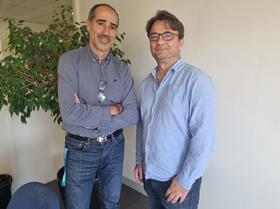
Laurent Pison brings more than two decades of experience as an architect for 2G/3G PMR and public telecom networks, complemented by 15 years of expertise in end-to-end 4G/5G solutions for vertical markets.
Thierry Aste brings more than 30 years of experience in the telecommunications industry, with a strong background in network engineering and operations, and specialised expertise in Product Line Management for 2G, 4G, and 5G solutions.





No comments yet