



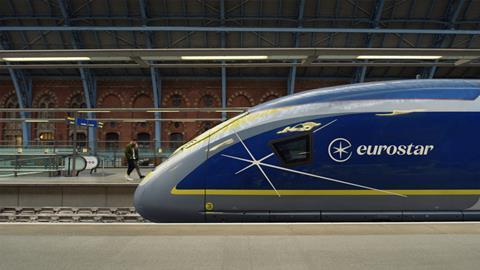
Eurostar’s new economic impact report with Public First puts its UK contribution at £2 billion and 23,000 jobs today, rising to £2.7 billion and more than 40,000 jobs by 2035. Chief Executive Gwendoline Cazenave said reaching that trajectory depends on bold UK capacity decisions.
Eurostar’s UK economic contribution is projected to grow from £2 billion and 23,000 jobs in 2025 to £2.8 billion and 40,000 jobs by 2035, according to a new economic impact report, Fast track to growth, produced for the operator by economic consultancy Public First. But at the report’s London launch, which Global Railway Review attended, Eurostar Chief Executive Gwendoline Cazenave warned that reaching that trajectory depends on decisions outside the company’s control.

Genuine growth, not redistribution
“The UK now needs a bold vision to match the private investment on the table,” Gwendoline said, “more depot capacity, a bold expansion of St Pancras and a seamless border.” Part of that private investment is Eurostar’s own £1.7 billion order for up to 50 new double-decker Celestia trains, the first of which enters service in 2031 and which will support the new Frankfurt and Geneva routes. The report states that Eurostar plans to develop its Temple Mills depot to maintain the new fleet, creating 350 skilled jobs, and puts the wider productivity case in numbers: Eurostar’s economic activity generates around £87,500 of gross value added per job, 9% above the UK average, with each direct role supporting an estimated 16 further jobs in engineering, supply chains, hospitality and tourism.
Lyne Biewinga, Executive Director of the Netherlands British Chamber of Commerce, echoed the call, setting out three requirements for unlocking further growth.
“It means three things,” she said. “A bold approach to people mobility, that enables people to move efficiently between the UK and the mainland. Secondly, infrastructure capacity to support future growth, including additional station and depot space, both in the Netherlands and the UK. And thirdly, a competitive, predictable business environment that encourages investment and innovation in international rail.”
“A bold approach to people mobility, that enables people to move efficiently between the UK and the mainland. Secondly, infrastructure capacity to support future growth, including additional station and depot space, both in the Netherlands and the UK. And thirdly, a competitive, predictable business environment that encourages investment and innovation in international rail” — Lyne Biewinga, Executive Director, Netherlands British Chamber of Commerce
The prize for the UK
Dame Emily Thornberry MP, Chair of the Foreign Affairs Committee and MP for Islington South and Finsbury, noted that Eurostar’s headquarters in her constituency already supports 400 local jobs, and pointed to the report’s 2035 projection to make the case for further investment. The report finds a wider effect around the station itself: about one in 20 businesses near St Pancras cited Eurostar as a factor in choosing to locate there, representing some 2,000 jobs in the area.
“Imagine where we could be by 2035,” Emily said, “if we invested more in infrastructure like Eurostar, if we built more depots, if we carried more trains, if we introduced more routes.”
Tim Leunig, Economics Director at Public First and visiting professor at LSE, said the report’s most striking finding was not that Eurostar benefits the UK economy, but how. “What surprised us was how much of that value comes through competitiveness – more productive businesses, higher-quality jobs and connectivity that has made King’s Cross one of Europe’s leading investment destinations,” he said.
Eurostar has carried more than 400 million passengers since services began 30 years ago.
“Imagine where we could be by 2035, if we invested more in infrastructure like Eurostar, if we built more depots, if we carried more trains, if we introduced more routes” — Dame Emily Thornberry MP, Chair of the Foreign Affairs Committee
Growth already reshaping UK aviation
Tim pointed to an effect the report itself quantifies: it estimates the new Frankfurt and Geneva routes could free up to 20 aviation slot pairs per day at London’s airports, as short-haul flights are replaced by rail.
“When a flight doesn’t have to leave Britain for Amsterdam, that flight can leave Britain for somewhere else – a new destination in China, in India, in Indonesia or an extra flight to San Francisco and Silicon Valley,” he said. “All of that is good for GDP.”











No comments yet