

LNER’s digital chief Danny Gonzalez explains how digital and data tools are reshaping network operations, performance and the customer experience.
In December 2025, LNER delivered the biggest timetable change on the East Coast Main Line in more than a decade – adding 10,000 extra services a year and 60,000 seats each week, unlocking economic value for communities across the UK. As one of the country’s busiest rail routes, the increase in capacity created a new level of operational complexity. With tighter turnarounds, reduced dwell times and increased pressure across the network, maintaining performance was key to delivering a successful timetable.
Performance is shaped by decisions and actions made across multiple people, systems and partner organisations. There is no single solution to improve it. Inconsistent data and manual processes make it harder to respond to incidents and plan long-term improvements. Digital transformation offered an opportunity to equip colleagues with real-time data, predictive insights and decision-support tools to help them act faster and with greater confidence.
The digital and innovation team, collaborating with operations, is embarking on an ambitious Operational Digital Transformation programme – a rare strategic opportunity to build new capabilities that transform how performance and operational decisions are managed. The new Intelligent Data Platform will bring together cleaner, richer and better-connected data to underpin AI, automation and machine learning solutions where they add genuine value. This will enable a predictive, connected operational ecosystem to spot issues before they escalate, support predictive modelling, strengthen causation analysis and provide real-time visibility of everything from passenger flows to unified operational data.
These intelligent, user-centred tools will give colleagues a clearer picture of what is happening across the network, reduce manual effort and enhance decision making – improving reliability, resilience and recovery – ultimately providing a better experience for customers.
Alongside this future-focused programme, the team has spent the past year working with frontline and operational colleagues to develop core tools, modernise and automate processes and trial new-to-rail technology through proof of concepts. A consistent thread is co-creating solutions – ensuring every product solves a real operational need and is shaped by the people who use it.
Modernising decision making in the Rail Operating Centre
The service delivery team at the Rail Operating Centre (ROC) plays a vital role in keeping the railway moving. Controllers make thousands of decisions every day, drawing on their expertise, judgement and the information available to them. The systems they use today support this work, but they have not been updated for some time – this presented an opportunity for modernisation. The digital team have partnered with subject matter experts to evolve simple documents and manual updates into more streamlined, digital tools, with the aim of reducing duplication, improving consistency and giving colleagues faster, clearer information when it matters most.
Service amendments tool
During disruption, senior train service managers must quickly assess the scale of an issue and balance customer volumes, crew and fleet availability, capacity constraints and customer impact. This is done manually and copied into separate documents to share with colleagues – a time-consuming process during fast-moving situations.
The new service amendments system will bring multiple data sources into one view to significantly reduce manual work. It will assess the scale of disruption, pull in live operational data and present viable alternative stopping patterns or timetable options. Controllers will still make final decisions, but with clearer visibility and fewer manual steps. The result will be the creation of faster, more consistent plans to share with colleagues and customers.
Ticket acceptance automation
When a train is cancelled, giving customers alternative travel options is important. Agreeing ticket acceptance requires multiple phone calls, manual checks and retyping information across systems. If details from other operators are inconsistent, controllers must spend time verifying them.
LNER’s Ticket Acceptance Project will streamline and standardise the process. By automating key steps and digitising the process, the system will provide controllers with accurate, consistent information upfront. Controllers will remain the decision-makers – the technology will simply reduce admin, improve accuracy and speed up decisions, to deliver clearer, quicker guidance for colleagues and customers.
Live train tracking tool
Real-time information is critical during disruption. Taking a test and learn approach, the team ran a proof-of-concept in the ROC, trialling a real-time tracking system that offered a clear, up-to-date picture of what was happening on the network. It brought together live train locations, passenger numbers and key operational information into one easy-to-use view, to help colleagues spot issues earlier and make quicker, more confident decisions. It also provided deep performance insight by analysing journey times, quantifying subthreshold delays and highlighting poor-performing sections of the route to pinpoint where issues occur and why. Output and learnings from the proof-of-concept will feed into the wider programme and could lay the groundwork for more predictive tools in the future.
The Operational Planning Platform
Another focus was how LNER prepares its daily operating plan. Planners rely on manual spreadsheets to produce three essential documents – depot sheets, set diagrams and working timetables. This involves pulling data from multiple systems, checking for errors and rebuilding plans from scratch, increasing the risk of cancellations and inconsistent information.
The new Operational Planning Platform replaces this fragmented process with an intelligent system that automatically generates planning documents. Built with operational and planning teams, it provides a single source of truth for operational data, improving accuracy while reducing manual effort.
Planners have a streamlined interface to review, refine and optimise daily plans, supported by automated validation checks. By removing repetitive admin, the platform frees planners to focus on timetable optimisation – boosting revenue potential and strengthening operational resilience. It marks a shift from spreadsheet-driven planning to a modern, intelligent planning environment.
Empowering frontline teams with real-time insight
Frontline colleagues, particularly on train and station teams, play a crucial role in performance, dwell times and customer experience. But their responses were mostly reactive because they lacked personalised, real-time information.
The digital and innovation team has worked closely with colleagues to develop tools that empower them with timely, relevant insight – enabling teams to address issues before they escalate and deliver a smoother, more reliable railway.
Navigator delivers personalised operational insight
Navigator, LNER’s personalised colleague app, was originally created for booking on and off shifts. Through user insight and feedback, it has evolved into a core operational tool providing live train and passenger loading information, bike and wheelchair bookings, reservation views by coach and seat, busy service indicators and headcode, station and colleague search.
Navigator supports smoother boarding, better platform management and reduced dwell times. Every colleague has access, including travelling managers and those supporting during busy periods. Despite not being mandated, Navigator has usage above 90% and one of the highest Net Promoter Score (NPS) ratings of any internal tool.
Despite not being mandated, Navigator has usage above 90% and one of the highest Net Promoter Score ratings of any internal tool.
Predictive station delay tool
Subthreshold delays, those under three minutes, can add up and impact punctuality, cost and customer satisfaction. Many stem from operational or human factors, such as crowding at certain doors or dispatch readiness. Teams lacked a forward-looking view of which trains were most at risk.
LNER’s machine learning powered tool predicts which trains are likely to incur delays, identifies probable causes and provides a risk score, enabling teams to intervene proactively, for example, by repositioning staff ahead of a predicted crowding issue.
Since its launch, the tool has prevented nearly 4,800 delay minutes, including more than 2,700 subthreshold minutes, equating to significant financial benefit.
Exploring spatial computing for route learning
Diversionary route knowledge is essential for resilience during disruption – trains can only run via a diversion if the driver and train manager are trained on it. Route learning relies on cab experience, instructor availability and access to the route.
Diversionary route knowledge is essential for resilience during disruption.
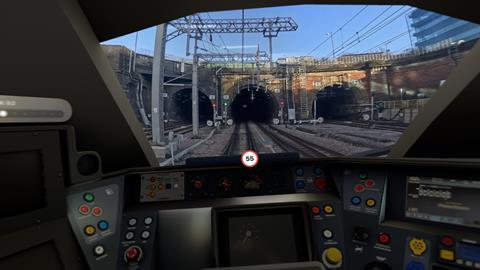
LNER is trialling Apple Vision Pro headsets to explore if immersive spatial computing could complement traditional training. The proof-of-concept recreates route environments using cab footage and 3D modelling to support understanding of complex infrastructure in a flexible digital setting. It is being developed with drivers and trainers from the outset to deliver a prototype. LNER will assess the feasibility, safety and scalability of this approach – providing evidence on whether immersive learning could play a role in the industry in the future.
DfT Operator (DFTO) innovation programme
LNER is collaborating with DfT Operator (DFTO) train operators through Future Labs, the public ownership innovation programme. One challenge focuses on reducing trespass, with incidents rising 15% year-on-year, causing significant delays and safety risks.
Future Labs is searching for technology or design-based solutions that detect and deter trespass at platform ends, particularly at unstaffed stations, without the need for costly barriers or staffing. Innovators can test solutions in one of the UK’s most complex operational environments, supported by operators and Network Rail.
Looking ahead to LNER’s next phase of digital transformation
The work to digitise and automate processes and manual tasks, strengthen data capture, reduce operational friction and equip frontline teams with predictive insight is not only supporting the focus on performance today – it is laying the foundations for the next phase of LNER’s transformation. The long-term vision is a predictive, fully connected railway where colleagues can access real-time data, model scenarios instantly and focus on delivering the outstanding customer experience LNER is known for.
The team is also considering how solutions developed today could be scaled across the wider industry – initially focusing on colleague digital tools and machine learning models. The work has the potential to reshape how the railway operates, collaborates and performs at a national level.



No comments yet