

Meerut metro launches with world first ETCS hybrid level 3 signalling
Posted: 23 February 2026 | Gabriel Higgins | No comments yet
Alstom and NCRTC inaugurate full Delhi-Ghaziabad-Meerut corridor with India’s fastest metro and advanced LTE 4G-based train control.
Credit: Alstom
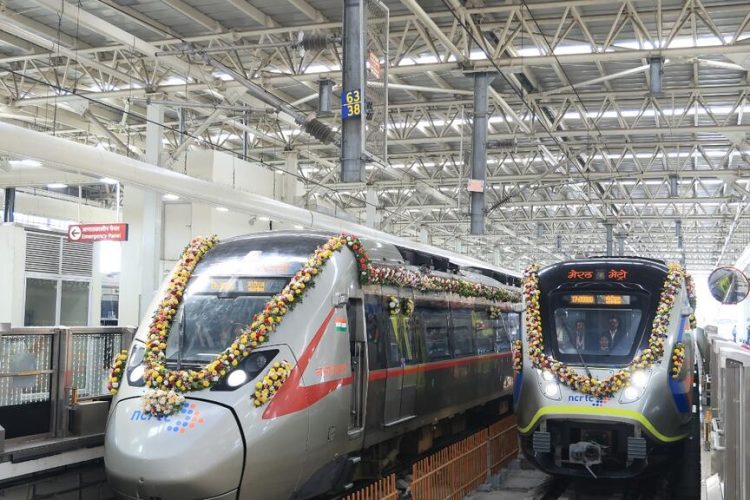
Alstom has marked the commencement of commercial operations on the balance stretch of the Delhi-Ghaziabad-Meerut Namo Bharat corridor, alongside the launch of the Meerut Metro, India’s first Regional Rapid Transit System and urban MRTS operating with ETCS Hybrid Level 3 over LTE 4G signalling.
The opening of the complete corridor for RRTS and commencement of revenue service for Meerut metro will unlock inter and intra city growth opportunities.”
The milestone, delivered by the National Capital Region Transport Corporation, completes key sections between New Ashok Nagar and Sarai Kale Khan, and Meerut South to Modipuram. The 21km Meerut Metro line connects 12 stations and integrates with the Delhi-Meerut Namo Bharat RRTS at four interchange points, strengthening inter-city and intra-city mobility across the National Capital Region.
Meerut Metro becomes the first system globally to deploy ETCS Hybrid Level 3 over LTE 4G for urban operations. The advanced signalling architecture enhances operational flexibility, safety and capacity while enabling more efficient train control. The trains have a design speed of 135km/h and a maximum operational speed of 120km/h, making them India’s fastest urban metro services.
Signalling innovation and Indian manufacturing
Olivier Loison, Managing Director, Alstom India, said: “The opening of the complete corridor for RRTS and commencement of revenue service for Meerut metro will unlock inter and intra city growth opportunities through this advanced urban rail network. It will be our endeavour to support them in this feat in every possible way.”
The trainsets were designed at Alstom’s engineering centre in Hyderabad and manufactured at Savli, Gujarat, with propulsion and electrical systems produced at Maneja. The fleet is fully aligned with the government’s Make in India and Aatmanirbhar Bharat ambitions.
The MRTS trains are based on Alstom’s Adessia commuter platform and incorporate passenger-focused amenities including overhead luggage racks, onboard information screens and USB charging points. Accessibility provisions include wheelchair spaces and dedicated stretcher areas for medical emergencies. Emergency communication systems are integrated in compliance with international safety standards.
Under a 2020 contract award, Alstom’s scope covers the design, manufacture and delivery of 180 RRTS cars and 30 MRTS cars, alongside the supply and installation of signalling, train control, telecommunications, platform screen doors and LTE radio systems. The agreement also includes 15 years of maintenance services.
The RRTS programme is designed to relieve congestion in Delhi by enabling faster travel between the capital and satellite towns. It complements the expanding Delhi Metro network and represents a significant evolution in India’s commuter and regional rail capability.
Stay Connected with Global Railway Review — Subscribe for Free!
Get exclusive access to the latest rail industry insights from Global Railway Review — all tailored to your interests.
✅ Expert-Led Webinars – Gain insights from global industry leaders
✅ Weekly News & Reports – Rail project updates, thought leadership, and exclusive interviews
✅ Partner Innovations – Discover cutting-edge rail technologies
✅ Print/Digital Magazine – Enjoy two in-depth issues per year, packed with expert content
Choose the updates that matter most to you. Sign up now to stay informed, inspired, and connected — all for free!
Thank you for being part of our community. Let’s keep shaping the future of rail together!
Related topics
Automatic Train Operation/Autonomous Train Control (ATO/ATC), Digitalisation, European Train Control System (ETCS), High-Speed Rail, Infrastructure Developments, Passenger Experience/Satisfaction, Rolling Stock Orders/Developments, Signalling, Control & Communications, Sustainability/Decarbonisation, Technology & Software