

Support needed for rail supply industry to play role in decarbonising rail freight
Posted: 16 February 2026 | Hugo Tabouret | No comments yet
Hugo Tabouret, Technical Affairs Manager at UNIFE, warns that without urgent support for the rail freight ecosystem, the sector risks obsolescence – with serious consequences for both industry and climate goals.
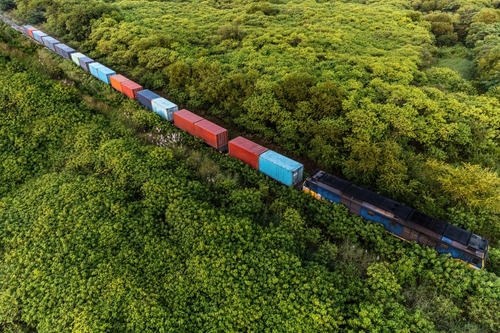
Without sizeable modal shifts and urgent support to rail freight, Europe will not meet its medium and long-term climate targets. The EU has pledged to be climate neutral by 2050, with debate on-going to set a 90% target by 2040.
To ensure that Europe’s transport networks are sufficiently decarbonised from a freight perspective, there needs to be major consideration and support for the processes and companies tasked with delivering the products which will be central to decarbonisation.
Without sizeable modal shifts and urgent support to rail freight, Europe risks failing its climate targets – and the industry faces obsolescence.”
As the recent Net Zero Logistics Study mostly touched on issues faced by operators and vehicle keepers, we believe solving the challenges our industry faces will also help ensure that Europe’s rail freight networks can be radically overhauled to improve profitability, while delivering significant emissions reductions.
At UNIFE, we see three key pillars – Digitalisation, Policy and Innovation – which are vital to achieving this goal.
Digitalisation
As debate continues concerning the allocation of future funding for European rail networks over the next EU mandate, digitalisation is a major pillar to ensure that rail freight has the technologies and the digital systems required to support rail operations.
These technological improvements and on-going digitalisation (like the European Rail Traffic Management System, Digital Automatic Coupling), will make the overall system more efficient by increasing headway, frequency and generally boosting productivity across the sector.
Policymakers already know this. As part of the headline Draghi and Letta Reports which seek to boost European competitiveness and play a big part in shaping the EU’s current agenda, ERTMS was mentioned as a central part of ensuring a boost in European productivity, from both a logistics and passenger point of view.
While we understand some reticence and note the challenges for European freight operators, DAC has the ability to boost competitiveness of rail, through boosting capacity for both freight and passenger services. It is one of the technical improvements which will radically streamline operations, while saving time, money and boosting safety.
UNIFE has been tirelessly involved in ensuring these technologies will receive the resources required from policy and decision makers across Europe. Alongside this, ensuring that support will be given to those producing and operating these technologies is just as vital.
Policy – technical standards, specifications and authorisations
Our valued members are private companies, answering requests from their customers.
It is particularly important, when defining new specifications and standards, to take into account the introduction of the product in the market, and the potential impacts on costs that the sector is able to bare. It might be the critical difference that ensures customers are not willing or not financially able to purchase the relevant goods.
This becomes a major issue if this pertains to critical technology required to drive modal shift and to improve rail freight operations. Because of this, more regulatory frameworks and authorisation processes must be simplified, if we want to see a better and faster reach of disruptive new technologies for rail freight in the market.
All rail stakeholders also need to be strongly supported by the EU-RAIL, the European Commission and the European Union Agency for Railways. While UNIFE does have a strong working relationship with these bodies, we’re always trying to improve these processes and ensure regulatory stability for the industry and sector.
This includes suggested simplification to the process of Vehicle Authorisation, which removes unnecessary hurdles. When it comes to the development of the Technical Specifications for Interoperability, UNIFE strongly advocates harmonisation, which ensures that there is one approach to specifications that governs all of Europe.
Further to this, the rail supply industry also needs a certain stability in the technical regulations, and therefore needs a reduction in short-term revisions.
There also needs to be ongoing support for a level-playing field from broader policymakers.
Investing in research, innovation & deployment
Technology always needs to be refined. The current technology which underpins railway signalling functions is GSM-R (Global System for Mobile Communications – Railway). As part of the FP2-MORANE-2 project, prototypes for the Future FRMCS (Future Railway Mobile Communication System) are being tested in three European laboratories under real track conditions, including on both conventional and high-speed lines.
This is due to the impending obsolescence of (GSM-R), and the need to establish a new communications system which will further digitalise the railway system.
This is only made possible through Europe’s Rail Joint Undertaking (EU-RAIL) programme, where UNIFE and the railway community can work with policymakers to undertake such research. We argue it is crucial that our members continue to spend resources and money in a range of R&I developments and EU-RAIL projects, alongside significant investments made by the European Commission.
Rail freight has immense opportunities to modernise and become Europe’s logistics backbone – but only with unwavering political support and investment in technology and innovation.”
Ensuring a successor to EU-RAIL under the upcoming Multiannual Financial Framework of the European Union is crucial for system-level innovation and research in rail, as it ensures the participation of both the industry and rail operating community. R&I is a key success factor in maintaining the competitiveness and global market leadership of the European rail supply industry. It is where solutions are commonly defined, discussed and agreed.
Once that technology is refined through these on-going research programmes, it needs to be deployed via significant and consistent investment through partnerships between the European Commission, Member States and unlocking private investment.
A sensible migration strategy of these future technologies must be developed in this instance, especially as it is central to improving profitability of rail freight, as the industry currently faces sizeable losses at its current level of technological sophistication.
Rail freight has immense opportunities to modernise, increase its modal share, and become the backbone of logistics transport in Europe. The challenge of decarbonising rail freight is something the rail supply industry can assist with, but only with the support of policymakers.
It is crucial we prioritise rail freight transport with unwavering political support, allocating the necessary financial resources for cutting-edge technology, research, and development to ensure its future growth. We cannot afford to continue neglecting this vital sector, risking its decline, as we need to make significant cuts to transport emissions.

Hugo Tabouret is a Technical Affairs Manager at UNIFE and is actively involved in shaping European rail industry standards. He works on regulation, standardisation and system-level technical affairs. He holds a background in engineering, with experience at Alstom, Toyota and other international companies.
Stay Connected with Global Railway Review — Subscribe for Free!
Get exclusive access to the latest rail industry insights from Global Railway Review — all tailored to your interests.
✅ Expert-Led Webinars – Gain insights from global industry leaders
✅ Weekly News & Reports – Rail project updates, thought leadership, and exclusive interviews
✅ Partner Innovations – Discover cutting-edge rail technologies
✅ Print/Digital Magazine – Enjoy two in-depth issues per year, packed with expert content
Choose the updates that matter most to you. Sign up now to stay informed, inspired, and connected — all for free!
Thank you for being part of our community. Let’s keep shaping the future of rail together!
Related topics
Digital Automatic Coupling (DAC), Digitalisation, European Rail Traffic Management System (ERTMS), Freight, Interoperability & Liberalisation, Standardisation & Technical Harmonisation
Related organisations
EU-RAIL, European Commission, European Rail Joint Undertaking, European Union Agency for Railways, FP2-MORANE-2 project, UNIFE (the European Rail Supply Industry)
Related regions
Benelux, Central Europe, European Union, France, Germany, Italy, Northern Europe, Southern Europe, Western Europe