

Alstom is testing a new ERTMS system on the León–Bilbao metre-gauge line, combining satellite sensors and digital networks to enhance safety and efficiency.
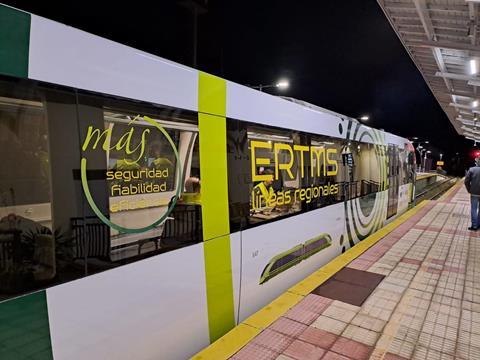
Alstom’s innovative signalling technology is powering Adif’s new European Rail Traffic Management System (ERTMS) application for secondary railway lines with low traffic density. Testing began this November on the metre-gauge section between La Asunción Universidad and Guardo, part of the León–Bilbao line.
“This initiative underscores Alstom’s commitment to innovation and safety in rail transport, contributing to greater interoperability and efficiency across the network. We are proud to collaborate with Adif on this important project, which represents a significant step forward in enhancing the reliability and sustainability of rail operations in Spain,” said Gustavo Mateos, Managing Director of the Signalling, Infrastructure and Railway Safety Unit at Alstom Spain and Portugal.
The innovation project was developed by Alstom’s Centre of Excellence in Railway Safety and Signalling in Madrid. Among its main innovations is the hybridisation of sensors, including satellite sensors, for train positioning, combined with public telecommunications networks. This ERTMS Level 2 application is designed to reduce trackside equipment while maintaining the same safety standards as conventional systems installed on high-speed lines. Level 1 trials will also be conducted to test new operational scenarios such as level crossing management.
System testing will continue through the first half of 2026, beginning with odometry measurement verification by the ERTMS equipment installed on trains. Level 1 tests will be carried out first, followed by Level 2 trials. The project aims to provide a reliable, interoperable solution for secondary lines, ensuring safety while improving efficiency, capacity, and service quality.
In April 2023, Adif awarded Alstom the contract to develop this innovation project. The project focuses on R&D&I to implement ERTMS on low-density local and regional lines, incorporating satellite technology and public communication networks instead of GSM-R networks. It demonstrates the feasibility of extending advanced signalling standards beyond high-speed mainlines at a lower cost while retaining safety and interoperability.
ERTMS is the European Union’s most advanced train command and control system, widely deployed on international lines to improve safe, interoperable railway operations. However, its adoption on secondary lines has been limited due to high costs and technical challenges. The new Level 2 application will bring the advantages of ERTMS to these lines, including reduced headways between trains, lower operating costs, and enhanced reliability.
Alstom has a strong track record in Spain, with over 800 experts working across its signalling and digital mobility operations, supported by a Centre of Excellence and testing laboratories in Madrid, and project management hubs in León, Sitges, and Málaga. Over the past two decades, Alstom has delivered pioneering projects, including the first ATP system on the Mediterranean Corridor, the first driverless rail system at Madrid Airport, the first ERTMS Level 2 system without Level 1 support on the Albacete–Alicante high-speed line, and ongoing automation projects for Metro de Madrid.
With more than 30 years of experience in signalling, Alstom has completed 135 ERTMS/ETCS projects worldwide, installed over 19,200 onboard units, and supervised more than 46,000 kilometres of track. This latest project continues Alstom’s mission to modernise Spain’s rail network, offering advanced technology to secondary lines while promoting innovation, safety, and sustainability.
Gustavo Mateos added, “Alstom is supporting Adif’s efforts to modernise Spain’s rail network by providing advanced technology to implement the European Rail Traffic Management System on secondary lines.”
Topics
- Adif
- Alstom
- Alstom Centre of Excellence in Railway Safety and Signalling
- Civils & structures
- Digital delivery & change
- ERTMS/ETCS programmes
- European Union
- Gustavo Mateos
- Maintenance, renewals & possessions
- Safety management & assurance
- Service performance & disruption management
- Spain
- Timetabling & capacity
- Traffic management & control centres
- Workforce strategy & skills